2. A Brief History of Glass
Beginnings
Natural glass has existed since the infancy of Earth itself. It is formed when certain types of rocks melt due to high-temperatures caused by volcanic eruptions, lightning strikes or the impact of meteorites, and then cooled and solidified rapidly.
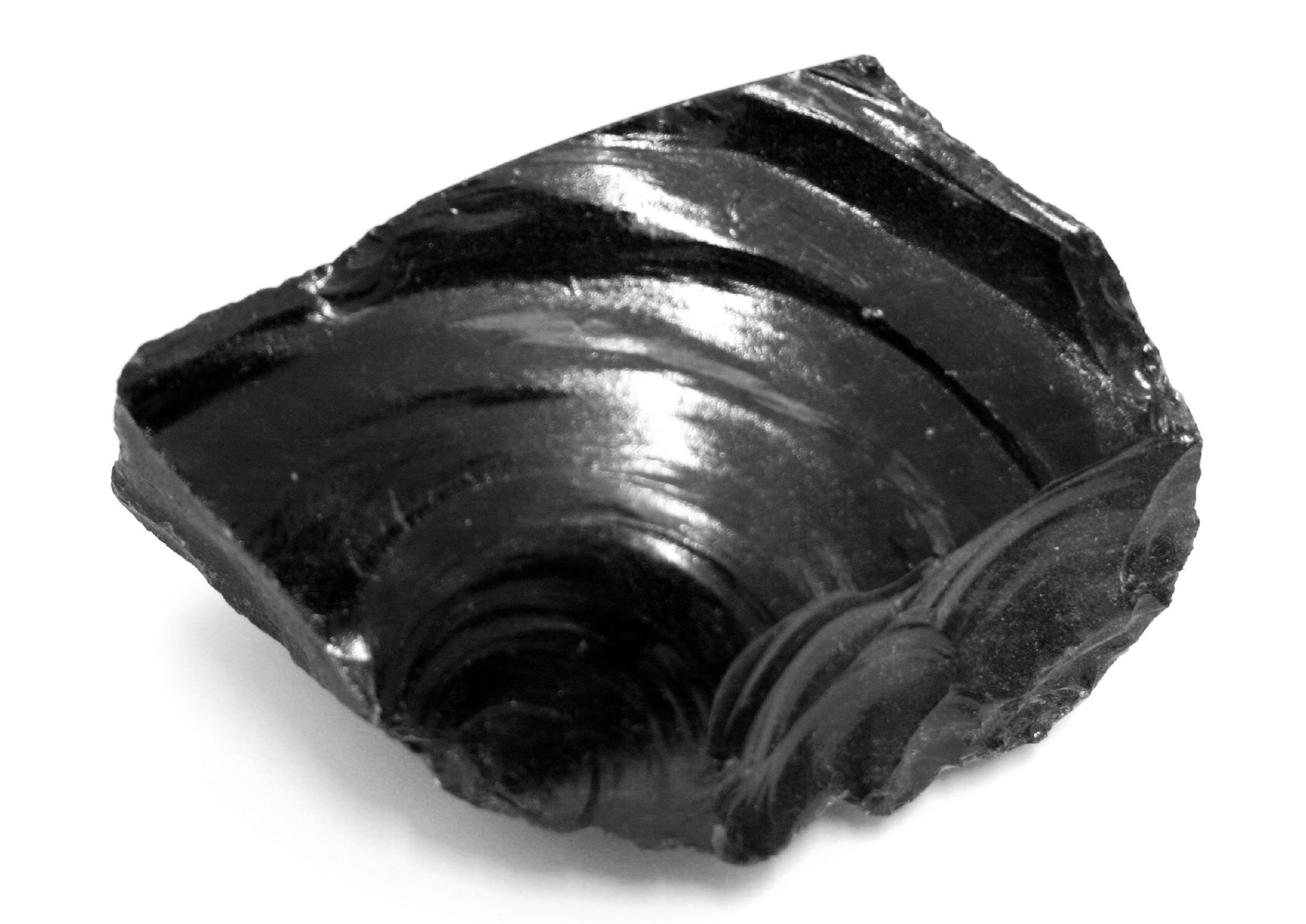
Naturally occurring glass, such as obsidian, has been used since the Stone Age. Primitive tools chipped from natural volcanic glass appear to have been used since about 48,000 BCE.1 Beads of glazed stone have been dated to at least 4000 BCE.2
- Figure 1: Obsidian (Natural Volcanic Glass)
Photo by Kevin Walsh
The origins of ‘artificial’ glass are lost in the misty origins of civilization itself. Pliny the Elder (23–79 CE), Roman commander and encyclopedist, gives us an early account of the origins of glass. (As Commander of the Roman Fleet, Pliny perished attempting to rescue survivors of the volcanic eruption of Vesuvius.3) In his Natural History Vol. 36 he relates:
There is a story that once a ship belonging to some traders in natural soda put in here and that they scattered along the shore to prepare a meal. Since, however, no stones suitable for supporting their cauldrons were forthcoming, they rested them on lumps of soda from their cargo. When these became heated and were completely mingled with the sand on the beach a strange translucent liquid flowed forth in streams; and this, it is said, was the origin of glass.3
Thus, according to Pliny, did humanity chance upon the recipe for making glass. As it turns out, with a really roaring campfire made with dry hardwood it is possible to barely soften existing glass (approx.1000˚C/1800˚F). To make new glass (with sand plus an alkali like sodium carbonate) it takes temperatures more like 1500˚C/2700˚F. Is Pliny’s story even possible? One wonders...
Natural glass is made in processes which humans can’t observe and imitate (e.g. inside volcanoes). Artificial glass requires sand, and alkali (to lower the melting point), heated to temperatures that require a real furnace. (Such a furnace would not be trivial to build and operate). So we have no way of knowing anything about the long forgotten divine lunatic heating combinations of materials in a furnace just to see what happened (and that could be hazardous), or making something else when some artificial glass was accidentally made somehow and they had the wit and gumption to follow up on it — thus discovering/inventing glass.5
Egypt
Human-made glass apparently originated in the pre-history of Eastern Mediterranean countries, perhaps Egypt. Mesopotamia seems to have had a flourishing glass industry around 2000 BCE, manufacturing non-transparent beads and other simple objects in fairly large quantities, with the occasional finely molded piece for the royal customer.6
Then in the fourth century BCE, Alexander the Great conquered one of the largest empires of the ancient world, and founded Alexandria in 331 BCE. Alexandria became a economic hub of the ancient world, and glass making followed the money. Alexandrian glass products quickly captured export markets long enjoyed by Egypt, and those exports reached as far as England and Scandinavia.7
Apparently Alexandrian glass makers introduced their craft to Rome about the beginning of the Christian era.
It was about this time that we meet another divine lunatic, who had the crazy idea of taking a metal pipe, dipping one end of it into a pot of molten glass, and blowing. Metal pipes were relatively difficult to make and thus not commonplace or inexpensive in ancient times. So our divine lunatic took his uncommon metal pipe, stuck one end into molten glass and blew a bubble. And humanity was forever transformed.
This technique was almost certainly invented in Syria in the first century of the Christian era. There is no way of knowing how this invention came about — this method is quite unlike any method employed before in glass — or in any other material then or since (for example, there is no such thing as ‘bronze-blowing’). Glassblowing allowed the skilled artisan to create a far greater variety of glass objects in far less time than casting or other glass making techniques. This unprecedented idea — blowing a bubble of molten glass — must easily qualify as one of humanity’s truly great inventions.
The nature of the ancient glassblowing pipe itself is an interesting question. The pipe needs to be able to not only stand the heat, but also the heat differential — at one end will be molten glass, the other end will be at room temperature. The pipe also has to be about 1.5 m/5 ft long — much shorter than that and the glassblower will be scorched trying to get close enough to the furnace to put one end of the pipe into the molten glass; much longer than that and the pipe becomes unwieldy, especially with a blob of heavy molten glass on the end. (You have to start with much more glass on the end of the pipe than will end up in the finished piece, and molten glass is surprisingly heavy.) Thus the pipe also has to be rather strong, both physically and thermally. Certainly in ancient times metal is the only material that would meet all these requirements. (And metal pipes are still what we use today.)
The Egyptians around 2500 BCE were making copper pipes to a diameter a little under 4 cm/2 in by taking a flat piece of copper, rolling it into a pipe shape, and hammering the seam closed.8 Thus it’s clear that in ancient times they were capable of making, for example, a copper pipe that may have worked as a glassblowing pipe. Even in modern times, because molten glass is not only hot but also corrosive, modern glassblowing pipes are expensive tools incorporating significant modern metallurgy technology.
Although glass melts at about 650°C/1200°F, it needs to be considerably hotter than barely-melted to be ‘blow-able’. Furnaces in modern glassblowing shops (with natural gas, propane or electrically fired furnaces) keep the molten glass at about 1300°C/2300°F; ancient glassblowing shops (with wood-fired furnaces) may have had to make do with somewhat lower temperatures.
Curiously, although glass was known in India, China and Japan, they did virtually nothing to develop it beyond beads and such. Glass technology has been a peculiarly Western pursuit until modern times.9
Rome
With the rise of the Roman Empire, glass making once again followed the money — this time from Egypt to Rome, where it was embraced to a degree unrivaled even in modern times. The invention of glassblowing in particular coincided with the peak of Roman civilization — glass vessels were produced cheaply and in large quantities. Fine pieces became highly prized and symbols of wealth. “Its success was so great that it began to undermine its main competitor, ceramics. Glass was principally used for containers of various kinds: dishes, bottles, jugs, cups, plates, spoons, even lamps and inkwells. It was also used for pavements, for coating walls, for forcing frames for seedlings, and even for drainpipes. It is no exaggeration to say that glass was used for a wider range of objects than at any other time in history, including the present. It was especially appreciated for the way it enhanced the attractiveness of the favourite Roman drink, wine.”10
Of the five main uses for glass — jewelry (glass beads, etc.), vessels (goblets and other domestic ware), windows, lenses, and mirrors — Rome developed jewelry and vessels most of all, although the other uses were known but not adopted to any great extent. (Although it might be a bit unfair to call it ‘Roman Glass’ when Rome was really relying on foreign glass artisans ‘acquired’ by the Empire.)
The first mention of glass in western literature (with the possible exception of the Bible) is in a speech by Cicero in 54 BCE in defense of Gaius Postumus at his trial:
‘Postumus’ ships were berthed in Puteoli and merchandise was talked about and seen. In reality, those goods were nothing more than cheap imitations made from paper, linen, and glass; and, although many ships were loaded with these, the whole lot together could not equal the debt.12
Window glass was apparently made by casting, and pieces of considerable size were made,11 but window glass was never particularly popular with the Romans — perhaps due to their mild climate. The farther north, the more commonly are windows found. In Britain and even into southern Scotland windows were quite common after the Roman invasion. It was in northern Europe that window technology developed and flourished after the fall of Rome.
The Romans knew how to make glass mirrors, yet they preferred metal ones. Archaeology has only uncovered a handful of Roman glass mirrors.
Similarly, the use of glass to magnify objects was probably known. A little glass ball filled with water may have been used for fine work such as engraving, but the Romans did not develop lenses or prisms.13
Glass making was at least attempted in every province that fell under the Roman yoke. And glass making persisted in the flotsam of the former Empire. Much of the production occurred on the edges of the old Empire. The Roman love of glass had spread as far as Afghanistan and the central Sahara, and as far north as Scotland and Scandinavian. “When the barbarians overran the Roman Empire, they had already absorbed glass as an essential part of their lives, and this tradition continued.”14
So glass making persisted. Different regions developed their own styles of glassware, of course. And windows became a high art form in the painted and stained glass windows of the medieval era. There are references to such windows from fifth century France onward; by 1000 painted glass is mentioned quite frequently in church records. The Benedictine order in particular gave impetus to window glass — they saw glass as a way of glorifying God through their involvement in its production in their monasteries, and invested enormous amounts of skill and money into its development.15
Venice
But like a Phoenix arising from the ashes of ancient Rome, another city arose in Italy to be the next center of glass making — Venice.
It seems likely that the tradition of glass making never died out in Italy, especially in the northern Adriatic area around Venice.16 Yet it was really from the thirteenth century that Italian, and particularly Venetian, glass making began to influence the whole of Europe. Venice in particular was blessed with a bay that facilitated trade, and with lagoon sand and alkali plants necessary for glass making. By 1268 the Venetian fiolarii (glass artisans) were apparently organized in a guild, and in 1271 a guild called the Capitolare was created, which included an agreement between the craftsmen represented by their gastaldo (magistrate) who was elected from among their members, and the Republic’s officials for the surveillance of the crafts. The Capitolare laid down the following rules for the workings of the glass-houses:
No glasshouse was to have fewer than three working-holes in their furnaces. These were to be fired with willow or alder. The working year was limited to the seven months from January to August, the rest of the year employed in the making-up of accounts, repairs and so on. The Capitolare also set out rules for the sales of products: No glass was to be imported into Venice. The export of products was to be carried out during that part of the year when the furnaces were idle, between August and January. Furthermore, an edict in 1275 forbade the export of sand, alum and glass fragments.17
The main edifice of the Capitolare of 1271 remained in place for more than five hundred years, in fact until the final formal dissolution of the guilds of the Venetian glass makers with the fall of Venice shortly after Napoleon conquered Italy in 1806.18
From early times glassblowers from Venice set up their glasshouses at Murano, a lagoon island situated about 5 km./3 mi. north of Venice; a rowboat could cover the distance in an hour. By a decree of 1292 the Grand Council of Venice encouraged the removal of all Venetian glass-houses to Murano, where the risks in the event of fire were smaller than in Venice itself. According to some historians, the glass makers were also encouraged to do so because, once established on the island, they were virtual prisoners, so strict were the regulations controlling the glass making industry against ‘industrial secrets’ becoming known abroad. On pain of death no craftsman could leave Moreno or even teach a resident foreigner any of the trade secrets without express permission — which was seldom given.19 There are even stories of relentless assassins in pursuit of fleeing glass makers — in one case, to the very gates of Prague, Czechoslovakia — over 500 km (300 miles) away.20
Of course truth and legend are difficult to separate here, but it is safe to say that very harsh measures were involved, since their ‘industrial secrets’ were of such enormous economic value. A register of 1454 specified the measures of the guild against a glassworker who fled. First he was strongly urged to return, and would receive a full pardon and a job. If he refused, his relatives were thrown into prison. If he still refused, an assassin was assigned. Two cases of murder of this kind are mentioned in Venetian archives, and there were probably more.21
As if the threat of assassins wasn’t enough, the life of glass makers wasn’t exactly easy either. According to a book in 1713:
Certainly no one could endure for long the strain of such work as these men have to do, nor could it be kept up except by robust men in the prime of life. During the process of making glass vessels the men stand continually half-naked in freezing winter weather near very hot furnaces and keep their eyes fixed on the fire and molten glass ... their eyes have to meet the full force of the fire ... they shrivel because their nature and substance ... is burnt up and destroyed by the excessive heat.22
(Modern glassblowers wear special goggles to protect their eyes from the intense infared and ultraviolet light emitted by glass furnaces.)
Though Venetian control over the glass makers and their families was strict, these craftsmen were also highly regarded. Many were given patrician standing, and their daughters permitted to marry noblemen.23 The government of Venice also conferred the title of “Gentleman” (no idle title in those days) on all who became accomplished in glass.24
By about 1300 the removal of glass makers from Venice to Murano was more or less complete, and to this day Murano has been the center for Venetian glass making.25 By the end of the sixteenth century, when Venice had about 170,000 inhabitants, Murano had a population of some 7,000, about 3,000 of whom are believed to have been directly concerned with glass making.26
By the early fourteenth century Venetian glass production was in full swing, and Venice’s vast fleet for war and commerce enabled her to trade as far as England and Flanders.27 Venice at this time was also “Queen of the Sea,” giving her ample facilities for exporting her manufacture to every part of the known world; and for a long period held the monopoly of supplying the cities of Europe with crystal glass.28
So important to Venice was the glass making craft that when Henry III of France visited Venice in 1574, it is said that his ship was greeted by glassblowers borne on a huge raft with a furnace in the shape of a mammoth sea monster spewing flames.29
James Howell, historian to Charles II, writes in 1621:
Murano, a little island about one mile from Venice, is the place where crystal glass is made, and it is a rare sight to see whole streets where on one side there are twenty furnaces at work. They say here, that although one should transfer a furnace from Murano to Venice, or to any of the little assembled islands about here, or to any other part of the earth beside, to use the same materials, the same workmen, the same fuel, and the selfsame ingredients every way, yet they cannot make crystal glass in that perfection for beauty and lustre as at Murano. Some impute it to the circumambient air, which is purified and attenuated by the concurrence of so many fires, that are in these furnaces night and day perpetually, for they are like the vestal fires, never going out.30
Not surprisingly, the strict secrecy for centuries surrounding Venetian glass making invested the art with an air of romance; and legends, probably invented for the purpose, created a maximum of mystique to the uninitiated.
And the Venetian glasshouses made the most of all this mystery. Venetian glass was so expensive that the modern practice of one glass per guest was actually unheard of as late as the 16th century. There might be only one glass to a table, so if there were two guests, “one should empty every time one drinks so as to leave nothing for his companion,” a situation presumably alleviated by the cup-bearer refilling the glass for the next guest.31
Even window glass was so expensive the glass panes were removed and put in a safe place when the occupants left the house for any time.32
One of the main innovations of the Venetian glass makers was a type of glass called cristallo, invented between 1450 and 1460.33 It could be blown very thin, was colorless and free from flaws, and enabled glass makers to make wonderfully elegant and intricate forms. And essential for our story, cristallo allowed wine glasses to be blown thin enough that they could sing.34
But with the fall of the Republic of Venice to Napoleon in 1797, the glass art of Murano suffered a swift decline.
Northern Europe
Glass making was certainly introduced into northern Europe by the Romans at the latest, but the glass making tradition there may date even earlier, to Celtic times.35 These glass houses were located in forests. Forests were used for hunting, for timber for houses and ships, and for fuel for domestic heating and commercial use — such as glass making. Glass makers were only rarely considered as primary claimants, more often they were delegated to hilly and remote country, where hunting was difficult and the timber not of prime quality.36 Sometimes the glass makers were used to clear the land of forests to make way for agriculture. These glass houses must have been small, informal structures, worked as long as the fuel supply immediately around the furnace lasted; when it was exhausted the furnace was left and another erected at a new location.37
But around the time of the Renaissance, as communication improved and demand increased, these itinerant furnaces gave way to permanent glasshouses.38 Glassworks were frequently located in areas where other industries were already established — glass makers and potters worked side by side in Lorraine, while ironworks were interspersed with glasshouses in northern Bohemia.39
From the early part of the sixteenth century, and especially from about 1550 onwards, great numbers of Italian glass makers traveled to the north and began working there, permanently or periodically, in spite of the protests of the Venetian authorities. Some Italian towns (such as Altare on the Ligurian coast) actually encouraged glassblowers to go abroad and work for certain periods of the year.40
In general, with the rise of the Renaissance and the improving economic conditions that accompanied it, glass making ‘à la façon de Venise’ (‘in the Viennese fashion’) as it was called, slowly disseminated throughout Europe, from France to Scandinavia.41
Alchemy
If changing common sand and burnt plants into a wondrous object of glass isn’t an alchemical transformation — then what is! If you can do that, changing lead into gold doesn’t seem so far fetched. Writing about glass making June 1, 1621, Howell says:
When I pry’d into the materials, and observed the furnaces and calcinations, the transubstantiations, the liquefactions that are incident to this art, my thoughts were raised to a higher Speculation... 42
Alchemy in the ancient world was far more than ‘changing lead into gold’, it was really proto-chemistry and proto-pharmacology.43 Alchemy certainly had its charlatans, but its devotees also worked out — through long, hard, and sometimes dangerous trial and error — processes for making now commonly used chemicals — like ‘aqua fortis’ (nitric acid) and ‘oil of vitriol’ (sulfuric acid)44. This practical knowledge was indispensable in the Alchemical Transformation of ancient alchemy into modern chemistry.45
And much of the modern chemist’s apparatus comes straight out of the alchemist’s laboratory. Neri, in The Art of Glass (1612), the first book on glass making, says:
[S]ome will, and perhaps with some reason, say that the invention of Glass was found out by the Alchymists; for they desiring to imitate jewels, found out glass; a thing perhaps not far from truth.46
In the ancient world, the centers of alchemy generally followed the centers of learning and commerce. Alchemy appears in ancient Egypt — at the same time as Egyptian glass. When the center of glass making moved to Alexandria, so did alchemy. And alchemy and glass migrated together to Rome.
Not surprisingly, the lines distinguishing metallurgy from alchemy and glass making were rather fuzzy until the founding of modern chemistry.47 In fact, in the glass literature as late as the early 20th century, glass was still referred to as another ‘metal’. After all, it was produced by similar means: take a certain type of ‘earth’ (sand, or ore), heat it in a hot furnace, and a remarkably different substance magically emerges. And there is a tradition of an attempt to find an ‘alloy’ of glass that was ‘malleable’ (flexible) in the same way that other ‘metals’ like copper are.
We can easily see how the modern clear distinction between ‘alchemist’ and ‘chemist’ was not so clear at all in Elizabethan days:
[Making iron] breedeth in like manner great expense and waste of wood, as doth the making of our pots and table vessels of glass, wherein is much loss, sith [since] it is so quickly broken; and yet (as I think) easy to be made tougher, if our alchemists could once find the true birth or production of the red man [iron], whose mixture would induce a metallic toughness unto it, whereby it should abide the hammer.58
In other words, the author is wondering if alchemists couldn’t make glass that is as tough as metal.
With the fall of Rome, the craft of glass working survived in the West (no literacy required to work glass), but the more learned and literate alchemy disappeared. Along with mathematics, the works of Plato and Aristotle, and so much of Western learning, alchemy was preserved by the Arabs in the Middle East. With the fall of Damascus and Constantinople in 1453, scholars and artisans fled west. They brought with them mathematics, and Aristotle, and new glass making techniques and alchemy.
Also, apparently a common belief of medieval and early Renaissance glassblowers was that a salamander lives in the furnace:
It was believed, too, that at certain times this wonderful being issued from his abode, and as opportunity offered, carried back some victim to his fiery bed. The absence of workmen, who sometimes departed secretly for foreign lands, was always accounted for by the hypothesis that in some unguarded moment they had fallen prey to the Salamander.
Visitors, too, whose courage could sustain them, were directed to look through the bye-hole to the interior of the furnace, and no one failed to discover the monster coiled in his glowing bed, and glaring with fiery eyes upon the intruder, much to his discomfiture, and effectually as to his retreat.48
The ‘salamander’ occurs frequently in the alchemical literature — a creature that lives in fire. This idea goes back to at least Aristotle, who describes it as a popular tradition which he himself had not observed.49
Furthermore, it was the custom for the workmen, in setting the pots of glass in the furnace, to protect themselves from the heat by dressing in the skins of animals from head to foot; to this ‘outer’ garb were added glass goggles, thus creating the most hideous-looking monsters. “Show was then made of themselves in the neighborhood, to the infinite alarm of children, old women, and others.”50
So it’s not too surprising that the line between glass artisans working all hours of the day and night, figuring out new kinds of glass and ways of coloring and working glass with furnaces, strange apparatus and chemicals, vs. alchemists working all hours of the day and night, figuring out who knows what with furnaces, strange apparatus and chemicals — well, what’s the difference?51
Fulcanelli goes so far as to assert, in his Le Mystère des Cathédrales (“Mystery of the Cathedrals”), that alchemical ‘secrets’ are displayed in plain view in the stained glass windows and statuary of various Gothic cathedrals.52
Not surprisingly, glass itself was regarded as having magical properties. Venetian glass in particular, when made under certain astronomical influences, would “fly into pieces” if any poisonous liquid was placed in them; and they sold vessels of this kind at enormous prices.53 In the 15th century, Philip Massinger would write of crystal glass:
Than hold one drop that’s venomous, of itself
It flies in pieces and deludes the traitor.54
Howell in a letter of June 1, 1621 repeats the same notion: “... a crystal glass ... hath this property above gold or silver, or any other mineral, to admit no poison.”55 In the same letter he goes on to quote a popular saying: “The first handsome woman that ever was made was made of Venice Glass.”
The inability of a wine glass to abide poison would certainly be a highly valued feature in Italy in the 14th through 16th centuries under the Borgias (notorious for poisoning and intrigue), as well as the houses of the nobility throughout Europe in general.
It turns out there might actually be some basis in science for the claim: glass of the time may have had low stability to anything even slightly corrosive — including poison.56
The mythology of Venetian glass shattered by poison was still current at the turn of the 19th century, as we can see in the novel The Mysteries of Udolpho (1794) by Radcliffe:
When the repast was over, they rose, and, each filling his goblet with wine from the gilded ewer, that stood beside him, drank ‘Success to our exploits!’ Montoni was lifting his goblet to his lips to drink this toast, when suddenly the wine hissed, rose to the brim, and, as he held the glass from him, it burst into a thousand pieces.
To him, who constantly used that sort of Venice glass, which had the quality of breaking, upon receiving poisoned liquor, a suspicion, that some of his guests had endeavoured to betray him, instantly occurred, and he ordered all the gates to be closed, drew his sword, and, looking round on them, who stood in silent amazement, exclaimed, ‘Here is a traitor among us; let those that are innocent, assist in discovering the guilty.’ 57
England
The supremacy and enormous profits of Venetian glass inspired attempts to make glass of similar quality in England. Initial unsuccessful attempts were made as early as 1530, but the real beginnings of a crystal glass industry in England date from 1567.59
In England, Holinshed, in his Chronicles (1577/1587) published during the reign of Elizabeth I, says:
It is a world to see in these our days, wherein gold and silver aboundeth, that our gentility, as loathing these metals, (because of the plenty) do now genrally choose rather the Venice Glasses, both for our wine and beer, than any of these metals, or stone, wherein before time we have been accustomed to drink, but such is the nature of man generally, that it most coveteth things difficult to be attained.... The poorest endeavor to have glasses also if they may; but as the Venetian is somewhat too dear for them, they content themselves with such as are made at home... 60
John Greene of London in 1670s asked that Venetian glasses being imported be made thick and heavy to withstand the hazards of transport by sea (and thick walls renders them incapable of singing).61
Essentially, at about 1550 wine glasses were either extraordinarily expensive Venetian imports or locally made glasses too thick for music making. But by about 1750, musically suitable wine glasses were sufficiently inexpensive and available that sets of musical glasses (with a couple dozen glasses in an instrument) had become common. This transformation of the wine glass in England from royal rarity to commonplace commodity came about from a variety of factors...
The Rise of the British Empire
Elizabeth I (1533–1603) ascended the throne in 1558, and under her reign England was transformed from an impoverished country torn apart by religious strife to one of the most powerful and prosperous countries in the world. Under her reign England defeated the Spanish Armada in 1588 — effectively establishing England as a world class sea power. This was good for English commercial shipping, which was good for English trade, and England prospered. A building boom ensued which needed plenty of windows. This was good for English glass makers.
Elizabeth I was succeeded by James I (1566–1625) who ascended the throne in 1603 and continued her economic policies. Under his reign, the King James Bible was commissioned and published in 1611. Under the reigns of Elizabeth I and James I, Shakespeare (1564–1616) wrote and produced his plays.

- Figure 2: “Hardwick Hall, More Glass Than Wall”
Photo by Amy Bradley
The glass making industry continued to prosper. All of England, and London in particular, was experiencing a construction boom, and glass windows were increasing in popularity. For example, “Hardwick Hall, more glass than wall” was completed by 1597. Occasionally a glass making house would be set up on the estate of a magnate building a new house which required extensive windows.62 And in 1666 the Great Fire of London, which raged for five days, destroyed approximately thirteen thousand dwelling-houses, eighty-nine churches, and St. Paul’s Cathedral.63 The good news is that the fire put an end to the Great Plague which had been tormenting the city. The other good news for glass makers is that reconstruction required yet more windows.
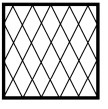
- Figure 3: A simple leaded glass window design
And glass was becoming popular in coaches as well.64 More importantly, England was beginning to see the rise of a middle class which wanted its own glassware of every sort to emulate the nobility.
By the way, ‘lead glass’ is a recipe for glass that includes lead, but ‘leaded glass’ is joining smaller pieces of glass into a larger window using lead strips to hold them together. This is because it wasn’t possible to make large plates of glass at the time — instead they created larger windows by joining together many smaller pieces of glass. Bessemer (in 1848) and others after him were able to make larger plates of glass at a high price. But large-scale production of large sheets of relatively inexpensive glass had to wait for the invention of ‘float glass’ in the 1950s, in which glass was floated on molten metal (such as tin) — gravity would do the work of making a large sheet of glass almost perfectly flat.
Fuel: From Wood to Coal
In 1550 glass making and iron making — both major industries in England — relied on wood for fuel. The growing demand for fuel for the growing glass and iron industries, for timber for shipbuilding, and for domestic building and heating was straining the English forests. Beginning in 1585, Parliament passed a steady of stream of legislation gradually prohibiting the use of wood-fired furnaces.65 As glass making switched to coal, new coal-fired glass furnace designs received new patents, effectively rendering the previous patents obsolete. (England was the first to use coal to fire glass furnaces.66) 1610 saw the first patent for a coal-fired furnace, only to be replaced by a patent for a newer model a year later.67 Before coal, glass making patents had been in force for decades; now they were being rendered obsolete in a few years. This helped transform glass making from a stagnant monopoly to full-fledged competition. Also, once glass makers were over the difficult transition to a new furnace technology, they found that coal was better than wood for firing glass furnaces — coal was hotter and more consistent.
Patents
‘Patents’ during the reign of Elizabeth I (1533–1603) were quite different from the modern idea: they were essentially government-imposed monopolies granted by the Crown. Initially these monopolies were intended to encourage the development of local industries by granting sole profits to local production as well as discouraging (if not outright prohibiting) imports by means of tariffs. During the reigns of Elizabeth I through Charles I (1600–1649), these monopolies became a way of financially rewarding loyal subjects without depleting the royal treasury. Better still, these ‘patents’ required an annual substantial ‘rent’ to be paid to the Crown, so not only was the loyal subject financially rewarded from the profits of their monopoly, but the Crown derived an income at the same time. This had the additional benefit of effectively imposing a tax, but the general population would blame the patent holder and not the Crown. Frequently the holder of a patent/monopoly might not even know anything about the industry over which he held a patent.
For example, by 1612 a satisfactory coal-fired glass furnace had been developed. And by 1615 the technique for firing glass furnaces with coal was sufficiently developed and in production to justify the granting of a monopoly. In “The Proclamation Touching Glasses” of that year the use of wood for glass furnaces was prohibited altogether, the import of glass from abroad was forbidden, and a royal monopoly for glass making in England was granted to a group of nine ‘adventurers’ at an annual rent of £1000. One of them, Sir Robert Mansell (1573–1656) soon bought out the others.68 Mansell was a vice-admiral in the Navy, and unacquainted with the glass industry.69
But the mood in England was increasingly against monopolies, because when a new monopoly was granted, long-standing businesses in that industry either had to submit to the newcomer monopoly holder or go out of business. The “Statute of Monopolies” of 1624 was intended to largely eliminate them, conferring monopoly powers to first inventors only. Glass making was specifically exempted, but the writing was on the wall.70 Unfortunately there were so many loopholes in the Act — and the Crown took full advantage of them — that the problem of monopolies was not really solved at all.71
The problem continued to worsen:
The practice of monopolies and all the evils it brought in its train rose to its greatest height in the reign of Charles I. The King’s almost frantic shifts for money and the illegalities and evasions he indulged in to fill his treasury rose to inordinate heights. Wine, soap, salt, and almost every article of domestic consumption fell into the hands of the monopolist and rose in price out of all proportion to the profit gained by the Crown.72
The Mansell monopoly on glass lasted until 1640. In that year Charles I was forced to summon Parliament for the first time in eleven years, and among their first decrees was to condemn and abolish Mansell’s glass monopoly.73
In 1649, all remaining patents/monopolies issued by the Crown, including glass making patents, were rendered null and void when the King of England, Charles I (1600–1649), was beheaded in the English Civil War and replaced by Oliver Cromwell, the ‘Lord Protector.’ Upon Cromwell’s death in 1658 his son Richard briefly succeeded him, but soon abdicated. The monarchy was restored in 1660 when Charles II was crowned King. The new king was all too mindful of the grief that the old patents/monopolies had caused his unhappy predecessor. Consequently he rarely granted monopolies per se, allowing the Statute of Monopolies of 1624 to function. This fostered an environment that increasingly looked like modern patents — a temporary monopoly granted to the original creator of a new technology.74
Innovation In General
With the weakening of monopolies and the general growth of the English economy, the pace of competition and profits increased and so did the pace of innovation. For example, Sir Kenelm (1603–1665) experimented with making stronger wine bottles, recommending that they be stopped “close with cork tied in.” Sir Kenelm was a glass maker and alchemist as well as a diplomat and naval commander — he defeated French and Venetian fleets in the harbor of Scanderoon (on the southeast coast of Turkey) in 1628, making him a national hero. (Sir Kenelm was also a founder of the Royal Society, which very much concerned itself with glass as well as other scientific matters. Benjamin Franklin would later be elected to this Society.) Bottle technology continued to develop, and around 1681 the corkscrew was invented, allowing the cork to be driven home flush. This ‘English bottle’ was soon an enormous international success since it allowed the storage and maturing of wine in the bottle. Furthermore, the wine bottle glass they had developed was not only strong but almost opaque, which protected the wine from the destructive effects of light. Alongside the new English lead glass (discussed below), “the dark glass bottle formed the spearhead of the English penetration of continental [European] markets, making England for the first time a net exporter of glass.”75
The Commercialization of Lead Glass
The commercialization of lead glass revolutionized glass making in England and made her one of the glass making capitols of the world. (‘Lead glass’ in which lead is mixed with the molton glass should not be confused with ‘leaded glass’ — windows made of smaller pieces of glass held together with lead such as in stained glass windows.)
In 1664 Charles II chartered the Worshipful Committee of Glass Sellers. At its formation the Company “made and sold looking glasses or mirrors, but only sold (it did not make) drinking or table glass, bottles, stoneware pots and other stoneware goods which were made for them by glass makers and pot makers, principally English, though some were imported, mostly from Venice.” From its inception, the Glass Sellers’ Company was entrusted with the “supervision of the glass and pot makers’ trades,” and was “empowered to search for and condemn all defective and deceitful ware.”76
Frustrated with the virtual monopoly on the glass industry enjoyed by the Venetians, the Company of Glass Sellers commissioned George Ravenscroft (1618–1681) to experiment with native raw materials. They wished to see England independent of foreign sources both for raw materials and finished glass.
In 1674 Ravenscroft petitioned the King for a patent for the making of a “sort of crystalline glass resembling rock crystal,” and this petition was in a note by the Attorney General that “the glass is of a finer sort and made of other ingredients than any other glasshouses in England have used, and that the invention may be of considerable public advantage as the glasses thereby equal, if not excel, those imported from Venice and France.” The patent was granted for a term of seven years, but already Ravenscroft had concluded an agreement with the Glass Sellers that they would “take and buy the said glasses of Ravenscroft...”77
Lead glass is generally credited to Ravenscroft even though he — like so many patent holders — was not particularly knowledgeable about glass making.78 Perhaps the knowledge came from a gaffer (master glassblower) in his employ named Giacomo da Costa.79 And the making of various kinds of lead glass is described in The Art of Glass (1611),80 a book published some 60 years before Ravenscroft's patent and well known to English glass workers. But even though Ravenscroft wasn’t personally responsible for the various technical innovations that resulted in his lead glass, he certainly made it a commercial success.
Lead glass was originally known as ‘flint glass’ because it was made with calcined flints instead of sand.81 (‘Calcination’ is a process in which ores are heated in a special furnace to remove impurities.) These calcined flints were available in England, eliminating the need to import Venetian cuogoli (a special sand).82 Lead glass was a far more brilliant and sparkling glass than had ever been made before. Besides the highly refractive appearance of lead crystal (which gives it its rainbow sparkles), lead glass was also much softer than regular glass, making it easier to engrave.
Ravenscroft’s lead glass incorporated three innovations: the first being the addition of lead. It had long been known that the addition of lead to glass gave it a high refraction; for this reason the Italians had used it when making imitations of precious stones. What was new in Ravenscroft’s use of lead was that he added it in greater quantities than anyone before. The second innovation was making the glass in coal-fired ‘wind furnaces’ which produced a stronger and more stable heat than wood-fired furnaces could give. The third was the use of the covered pot for the molten glass, which concentrated the heat inside the pot and prevented the dust given off by the coals from contaminating the glass.83
Ravenscroft’s original formulation for glass was subject to ‘crizzling’, a defect which produces an internal network of glistening lines and a gradual breakdown of the surface. “Crizzling is caused by instability in the glass, usually due at this period to the habit of boiling the fluxing alkali repeatedly in an effort to purify it. This resulted in a reduction of the calcium content. Calcium is a glass stabilizer, and without a stabilizer the alkali is leached out of glass by atmospheric action, leaving the silica network exposed and weakened.”84 Ravenscroft eventually solved this problem, as we can see from a statement issued by the Glass Sellers in the London Gazette June 3, 1676:
Wee under written doe certify and attest that the defect of the flint glasses (which were formerly observed to crissel and decay) hath been redressed severall months ago and the glasses since made have all proved durable and lasting as any glasses whatsoever. Moreover that the usual tryalls wherewith the essay of glasses are made have bene often reiterated on these new flint glasses with entire success and easy to be done againe by any body, which proofs the former glass would not undergoe, besides ye distinction of sound discernible by any person whatsoever.85
Here we see that stable and strong glass was still an ongoing area of research.
Lead glass certainly attracted the attention of foreign glass makers. Some foreigners were already working in English glasshouses and tried to establish lead glass abroad. The lack of proper fuel (coal) for the furnaces, and of proper clay for the glass pots must have proved an almost fatal handicap to the foreigner attempting to make English lead glass.86
In 1674 Ravenscroft obtained a patent for his invention (or at least important improvements) of lead glass. It was enormously successful. Ravenscroft died within a few days after the expiration of his seven-year patent.
The Excise Tax on Glass
Ever in need of more revenue, Parliament passed an Excise Tax on Glass in 1745 — a tax by weight on the materials out of which glass was made. This tax was increased in 1777, and again in 1822.87 The predictable result was that glass makers made their glasses thinner and lighter. “During the first forty-five years of the [18th] century, when there was no tax, and when glasses were sold by weight, there was every inducement to make simple massive glasses. During the period after 1745 there was an equal inducement to reduce the weight of the glass and to raise its value by other means.”88 In other words, make them thinner. (And thin glasses can be made to sing.)
So, due to the combination of all these forces — running out of forests and switching to coal, changes in the patent climate, the rise of the British Empire and a middle class that wanted glasses for themselves, the improvements in glass making technology in general, the Excise Tax on Glass — all these combined to reduce the price of glasses. By 1758 a dozen wine glasses could be bought for a mere 2 shillings — very approximately two ounces of silver,89 and happily for glass musicians the new thin design was conducive for music making. “The change was, of course, from an almost Venetian glass to one that is typically British. From a tall heavy glass, weighing often enough a solid pound, to a short light glass weighing a few ounces.”90
America
Glass making in America began at Jamestown, Virginia, in 1608. The English Board of Trade decided that glass making would be an ideal use for the limitless forests of the New World (much like glass houses had flourished in the forests of northern Europe centuries earlier). As we have seen, England at this time was running out of forests, forced to switch to coal, and domestic glass making was struggling with the conversion. So a glass factory was founded in Jamestown, operating in the nearby forest a little over a year after the first colonists arrived in England. This ‘tryal of glasse’ sent back to England that year was the first manufactured product of any kind, so it can be truly said that glass was America’s first industry. (Glass had already been made in the Western Hemisphere by Spanish craftsmen in Mexico around 1535.) It’s likely this first venture came to a close in the fall of 1609, and certainly came to a halt during ‘The Starving Time’ in 1609 to 1610 when all but 60 of the 500 inhabitants at Jamestown died.91 Another venture was attempted in 1621 (less than a year after the Pilgrims landed at Plymouth) but was abandoned in 1624. The record suggests that little if any glass was made.92
A lack of technical knowledge on the part of the English financiers, the terrible hardships of the New World (including weather, famine, and the Indians), the quarrelsome natures of the glassblowers sent to Jamestown (the good glassblowers had little reason to leave the ‘Old World’ where demand for their skills was high) and the sheer distance to the markets in England all combined to make these first attempts at glass production in the colonies a failure, in spite of the abundance of fuel and good sand.93
Later, once the colonies were firmly established, official British policy forbade all manufacture in their colonies: they were to produce raw materials for factories in England and provide a market for the finished goods. This included glass making. There were a few attempts at defying this policy. Caspar Wistar, a Philadelphia brass-button manufacturer who had immigrated from Germany, imported German glassblowers in 1739 and established a factory in southern New Jersey to make bottles and windows. This venture was successful enough to be left to his son, who however closed it in 1781, probably because of the American Revolution.94
Another was by Henry William Stiegel, also a German. Like Wistar he also imported workmen (no other way to get them), like Wistar he had problems keeping them (some of whom wanted to start their own factories). Both Wistar and Stiegel appealed unsuccessfully to the patriotism of their fellow citizens to buy American instead of imported glass. Stiegel so overextended himself financially with his three factories that he eventually went to debtor’s prison in 1774.95
After the American Revolution there were no more restrictions against manufacture, but British mercantile policies still made it difficult for American manufacturers to compete. Finally, when the Acts of Embargo of 1812 cut off the supply of British-made goods, American glass makers were for the first time free of ruinous competition. There were setbacks of course, but glass production increased during every decade throughout the nineteenth century.96
This brings our brief history of glass to a little past the time of Franklin. To be sure, both formulations of glass and techniques for working it continued to develop at an ever increasing pace. But we leave the continuing story of glass in modern times to others as we turn our attention to glass music.