5. Franklin and the Glass Armonica
Benjamin Franklin (1706–1790) was born in Boston, the 12th of 13 children. His father was a candle/soap maker, and expected Benjamin to follow in that trade. Consequently Benjamin only received two years of formal schooling.
Apprenticing Benjamin to be a candle/soap maker didn’t go well. So his father apprenticed Benjamin to his older brother James, a printer. The rest, as they say, is history. By 1748, at the age of 42, Franklin was financially successful enough to retire from business and devote himself to science and civic service.
In 1761 Franklin invented the glass armonica. In 1762 he wrote an extensive letter to Father Beccaria, professor of Physics at Turin, and to no one else. Of all the people to whom the now famous Franklin could write about his new invention, why Beccaria, and why just Beccaria? To answer that question we need to understand the story of Franklin’s electrical discoveries.
Franklin and Electricity
Retiring from business in 1748, Franklin was able to devote his attention to electrical experiments. Electricity was a burning unsolved problem of physics in his day, and in 1751 Franklin published his epochal Experiments and Observations on Electricity, in which he laid the foundations of our modern understanding.
At this point Franklin had absolutely no ‘credentials’ whatsoever — he had only completed two years of elementary schooling, certainly not professor of anything anywhere. And he lived in the frontier edge of nowhere that was Philadelphia in his day (population approximately 25,000).
Not surprisingly, Franklin’s ideas hardly received a warm a welcome in England or France. Not that Franklin didn’t have supporters in both countries from the beginning. But the British were inclined to look upon their colonials as semi-barbarians.
The French were more cordial, and it was the D’Alibard translation of Franklin’s works that “broke the English boycott” and brought Franklin’s name to universal attention. But France was more accustomed to originating new ideas herself than receiving them from foreigners (especially nobodies from nowhere), and Franklin’s ideas did arouse some resentment as a sort of threat to the French national pride. “This spirit of injured pride found its least inhibited expression in the antagonism of the huffy royal preceptor, the Abby Jean Antoine Nollet, who was reluctant to surrender a reputation freshly won with a plausible theory of effluvia to account for the action of electrified bodies.”1 At first Nollet thought that Franklin’s discoveries were a hoax by his enemies. When the reality of the threat to his prestige became clear, he counterattacked with a volume of nine Letters on Electricity (Paris, 1753). Six of the letters were destructive criticism addressed directly to Franklin. “Around Nollet rallied a formidable party of anti-Franklinists who, by virtue of the royal patronage enjoyed by their leader, exercised considerable influence in the schools and in the Royal Academy of Sciences, acting thereby as a strong obstacle to the acceptance of Franklin’s ideas.”2
Italy, however, had no such prejudices. The various wars of succession in Italy had come to an end with the treaty of Aix-la-Chapelle in 1748, so until the peninsula was caught in the maelstrom of revolution after 1795, the prevailing atmosphere was one of peaceful reform and accelerating intellectual activity. The sciences in particular profited from this improved environment.
In 1755 Francesco Algarotti wrote to a friend:
Behold from English America there comes to us not only tobacco and indigo, but also philosophical systems. From Philadelphia a Quaker [Franklin] has sent us the most beautiful observations, the most beautiful reasonings in the world on electricity; and all our European electricians must doff their hats to this American.3
So it’s not surprising that the Italians were stirred to immediate action by the news of the successful outcome of the experiments by French naturalist D’Alibard (who translated Franklin's book on electricity into French) and de Lor in May 1752, which established the fact of “atmospheric electricity” (lightning) in accordance with Franklin’s theories. At least four Italians corroborated the experiment before Franklin set up his own lightning rod back in Philadelphia in September of that year.
One of the Italians was Father Giambattista Beccaria (1716–1781), Professor of Experimental Physics at the University of Turin. His observations began on July 2 of that year, with a lightning rod erected on his own house. By the first week in August he had proved beyond doubt that clouds can be charged positively as well as negatively, an observation Franklin did not make until the following spring, and which he hesitated to announce until after the appearance of Beccaria’s first book on electricity.
Beccaria’s Dell’ Elettricismo Naturale ed Artificiale (“On Natural and Artificial Electricity”), published in Turin in 1753, “a most systematic exploitation of Franklin’s germinal ideas conducted according to mathematical expository method and bolstered with ingenious and meticulously controlled experimentation, gave the status of science to what had been in the main the amusement of dilettantes and the baggage of charlatans. Its author was immediately acclaimed as the leading electrologist by all the fair-minded, including Franklin.”4 Franklin’s opinion of Beccaria’s book was that it was “one of the best pieces on the subject in any language.”5 And Beccaria’s exhaustive experimentation made him an authority on the subject second to none.
Franklin was definitely at a disadvantage defending his ideas, being on the wrong side of the Atlantic and increasingly involved in political matters. He could hardly have found a better champion for his theories than Beccaria, who devoted the rest of his life to promoting and extending Franklin’s ideas on electricity, and to defeating all challengers.
In 1757 Algarotti wrote another letter:
Whoever would have believed a while ago that England, which was reputed to be a country of louts, would excel so and legislate in matters of science? ... Father Beccaria, with the most elegant and decisive experiments, is engaged in illustrating the system of Franklin; and Italy confirms more and more the laws of English electricity.6
By 1757 Franklin and Beccaria were corresponding — an exchange which continued for a quarter of a century until Beccaria’s death in 1781. Franklin never ceased to feel that he owed Beccaria a profound debt of gratitude. And Franklin’s recognition benefited Beccaria in turn: “so delighted was Beccaria’s sovereign for the recognition accorded his subject [by his association with the famed Franklin] that he immediately increased his stipend, awarded him a pension, and ‘in a thousand other most gracious ways manifested how great was his appreciation’.”1
Meanwhile, an invention of Franklin’s that put his electrical insights to practical use — the lightning rod — wasn’t immediately embraced with open arms either. One group that opposed them was essentially religious: lightning rods were “thwarting God’s will”; holy water and the ringing of church bells were the only unsacrilegious defense against lightning. The other group objected on a more scientific basis: the Marquis Chigi, for example, maintained that “electricity does not exist in the natural state, that lightning is not at all an electrical phenomenon, that pointed conductors can in no way keep lighting from forming, and that they are of no use in receiving and dispersing strokes.”8
Matters came to a head in 1777 when the Grand Duke ordered lightning rods to be placed on the cathedral and the Gothic tower of the city hall in Siena. Hot controversy divided the citizens of the little medieval city, with the Marquis Chigi on the one side and the university professors on the other. “Once the rod was up,” according to a contemporary report, “one can say that never was a wedding day awaited with so much anxiety as was a storm by the two parties.”9 Fortunately they didn’t have to wait long. A colleague at the University of Siena describes the spectacular event:
It will not be easy to find a similar observation attested in all its circumstances by a large number of people, who, in a thickly frequented public square, in plain daylight, and with all their attention, had their eyes turned toward an extremely high tower to observe the action of the conductor recently placed upon it, and who, without a long wait, had the fortune to admire, to the glory of Philosophy, the intelligence and the genius of the immortal Mr. Franklin, who, extending, so to speak, his prodigious hand over the square of Siena on the 18th of April, took by the hair a horrible lightning bolt and forced it to pass along a route mapped out by his great mind, with express orders not to damage a building on which it has so many times vented its furious strength. The people of Siena, always grateful to one who does good to humanity, are surprised that statues have so often been raised to those who have ruined cities and that they are so seldom raised to those who preserve them. If Mr. Franklin ... reads the present account, he will surely feel an ineffable consolation upon hearing about his fine triumph and the applause given to him by people so far from his country, who see in his marvelous lightning rod the most distinguished trophy of his immortal genius.10
One of Franklin’s lifelong dreams was to visit Italy, and his friend and colleague Beccaria — a visit that never happened.11 Neither would Beccaria’s king permit a visit to Franklin in Paris during the American Revolution — apparently afraid he would “take a liking to American maxims.”12
Franklin Invents the Glass Armonica
From 1757 to 1762 Franklin lived in London, lobbying Parliament on behalf of the Pennsylvania colonial legislature. His experiments with electricity had already made him famous in the scientific community, and the candle/soap maker’s son had reached the top of the political and social scene as well.
Franklin was keenly interested in music and had an extensive knowledge of it. He loved to sing, to write new words for old songs and played several instruments including the harp and the viol da gamba as a capable amateur.13 He also wrote a lengthy letter which amounts to an essay on music theory,14 and apparently composed a string quartet.15 Franklin also printed sheet music in his print shop.16 He seems to have surrounded himself with music wherever he lived.
On the other hand, Franklin apparently had little use for professional musicians (an attitude shared by the colonists in general): to illustrate social parasitism, he could think of no better symbol than a “fiddling man” whose activity results in no tangible product (bricks, for example) so that “either the poverty or the labor of the rest of mankind is increased.”17 During his first trip to France in 1767 he was more interested in the means the French used to ventilate their theaters than in the performances.18
His tastes were for ‘simple music’, Scottish airs in particular, and one of his letters is a rather scathing attack on Handel arias.19 In a letter of December 11, 1763 to Sir Alexander Dick, Franklin writes:
I play some of the softest tunes on my armonica, with which entertainment our people here are quite charmed and conceive the Scottish tunes to be the finest in the world. And indeed, there is so much simple beauty in many of them, that in my opinion they will never die, but in all ages find a number of admirers.20
Franklin attended concerts frequently. One was a charity performance of Handel’s Messiah at which Handel himself had been scheduled to perform on May 3, 1759, but Handel inconveniently died on April 14. The concert was conducted instead by Handel’s protégé John Smith, and still raised over £400.21 In France in 1781 Franklin attended a concert in which he narrowly escaped death when the opera house caught fire and burned.22
A less hazardous concert was on the musical glasses given by Delaval (whom we have already met), probably in 1761. It was from this concert that Franklin was inspired to invent a more ‘convenient’ arrangement of the glasses.23
It should be no surprise that Franklin devised an elegant design: he eliminated the nuisance of water tuning (and the problem of constant evaporation) by having each glass made with the correct size and thickness to give the desired pitch without water. And by nesting them inside each other and mounting them on a spindle which was turned by a foot treadle, he simultaneously made it possible to play five notes in each hand if wanted with less effort, and fit many more glasses/notes into a much smaller space.
Franklin contacted Hughes and Company at the Cockpit Glasshouse, and received the services of Charles James who made the glasses for the first instrument. Franklin’s new invention was announced in the Bristol Journal for January 12th, 1762:
The celebrated glassy-chord, invented by Mr. Franklin of Philadelphia: who has greatly improved the musical glasses, and formed them into a compleat instrument to accompany the voice; capable of a thorough bass, and never out of tune. Miss Davies from London, was to perform in the month of January, several favourite airs, English, Scotch and Italian, on the Glassychord (being the only one of the Kind that has yet been produced) accompanied occasionally with the voice and the German Flute.24
- Figure 25: Franklin's armonica, from the 2nd Italian publication of Franklin's letter to Beccaria
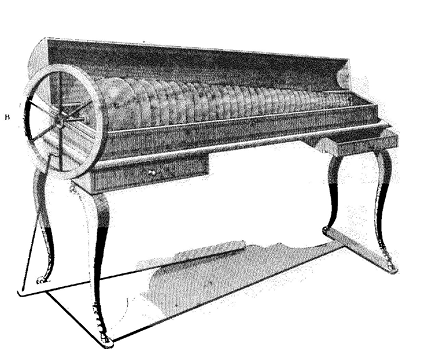
Thus Franklin’s initial name for his invention was the “glassy-chord,” a good, stout, practical English name. Its first public performance was by Marianne Davies, whom we shall consider shortly.
Franklin made plans to visit Italy — in part to visit his good friend Beccaria. But the visit wasn’t to be. On July 13, 1762, a month before sailing from England to end five years of service as colonial agent for the Province of Pennsylvania, Franklin took quill in hand to bid farewell to friends whom he could not see in person. Among them Father Beccaria: (The letter can be found in full in the appendix.)
London,
July 13, 1762
Reverend Sir,
I once promised myself the pleasure of seeing you at Turin, but as that is not now likely to happen, being just about returning to my native country, America, I sit down to take leave of you (among others of my European friends that I cannot see) by writing.
Franklin thanks Beccaria again for his work on electricity. He then turns his attention to the main topic of the letter, the glass armonica:
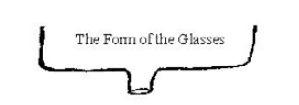
- Figure 26: Drawn by Franklin in his undated letter to Messrs. Huges & Co (PBF 10:180ff).
Perhaps, however, it may be agreeable to you, as you live in a musical country, to have an account of the new instrument lately added here to the great number that charming science was before possessed of: As it is an instrument that seems peculiarly adapted to Italian music, especially that of the soft and plaintive kind, I will endeavour to give you such a description of it, and of the manner of constructing it, that you, or any one of your friends may be enabled to imitate it, if you incline so to do, without being at the expence and trouble of the many experiments I have made in endeavouring to bring it to its present perfection.
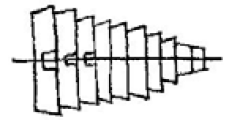
- Figure 27: Drawn by Franklin in his undated letter to Messrs. Huges & Co (PBF 10:180ff)
You have doubtless heard the sweet tone that is drawn from a drinking-glass, by passing a wet finger round its brim. One Mr. Pockeridge, a gentleman from Ireland, was the first who thought of playing tunes, formed of these tones. He collected a number of glasses of different sizes, fixed near each other on a table, and tuned them by putting into them water, more or less as each note required. The tones were brought out by passing his finger round their brims. He was unfortunately burnt there, with his instrument, in a fire which consumed the house he lived in. Mr. E. Delaval, a most ingenious member of our Royal Society, made one in imitation of it, with a better choice and form of glasses, which was the first I saw or heard.
If Delaval was the “first I saw or heard,” Franklin must not have attended any of Anne Ford’s notorious performances in London in 1760 and 1761. Franklin continues...
Being charmed by the sweetness of its tones, and the music he produced from it, I wished only to see the glasses disposed in a more convenient form, and brought together in a narrower compass, so as to admit of a greater number of tunes, and all within reach of hand to a person sitting before the instrument, which I accomplished, after various intermediate trials, and less commodious forms, both of glasses and construction, in the following manner.
Franklin goes into some detail about how to make an instrument, and adds instructions for marking the glasses:
To distinguish the glasses the more readily to the eye, I have painted the apparent parts of the glasses within side, every semitone white, and the other notes of the octave with the seven prismatic colours, viz. C, red; D, orange; E, yellow; F, green; G, blue; A, indigo; B, purple; and C, red again; so that glasses of the same colour (the white excepted) are always octaves to each other.
This particular system of associating colors and notes is not original. In the 18th century there was quite a bit of interest in the relationship between color and sound. Kicher had already discussed this at some length in his Musurgia Universalis (1650), and Isaac Newton in his landmark book Opticks (1704) related the sequence of prismatic colors to the notes of the scale — the same sequence Franklin used for his armonica.
At the time there was considerable interest in constructing a “color keyboard” (“color clavecin” or “ocular harpsichord”) on which visual art could be ‘played’. Father Louis Castel (1688–1757) particularly championed this idea — for which this Frenchman was elected to the Royal Society of London in 1730. Muller, writing in 1795 in Germany, specifically relates Franklin's color scheme for marking his glasses to Father Castel’s color keyboard.25
The famous composer Telemann translated Castel’s work into German, and Diderot, Rousseau and Voltaire weighed into the discussion. Various models were proposed from about 1750 on, including one by an anonymous inventor in London in 1757.
Franklin doesn’t appear to have been interested in “ocular harpsichords,” but certainly the idea of relating the colors of the rainbow to the notes of the scale was very much in vogue, and it would be quite natural for Franklin to use a music-to-color scheme popular in his day for his own invention.26
Franklin concludes his letter to Beccaria:
The advantages of this instrument are, that its tones are incomparably sweet beyond those of any other; that they may be swelled and softened at pleasure by stronger or weaker pressures of the finger, and continued to any length; and that the instrument, being once well tuned, never again wants tuning.
In honour of your musical language, I have borrowed from it the name of the instrument, calling it the Armonica.
With great esteem and respect, I am, Etc.
B. Franklin
Here Franklin called it the “armonica,” after the Italian for “harmony” which is “armonia.” It is curious that Franklin chose to unveil the new instrument as he did, communicating to an Italian and baptizing it with an Italian name, after it had become known about London as the “Glassy-Chord.” Furthermore, the correspondence between Franklin and Beccaria before and after the armonica letter contains no other comparable departure from scientific and personal matters.
Yet Franklin was nothing if not practical. As previously with his stove and lightning rod, he must have been anxious to see humanity blessed with his new invention as soon as possible. “That intent could obviously be no better served than by having his instrument adopted and cultivated in the land that was the musical Mecca to which the western world still turned for diversion and instruction. What then more logical than for him to dedicate his new instrument to a prominent Italian in order to take advantage of Italy’s musical hegemony? An Italian name for the invention, along with a national compliment or two for good measure, was probably calculated to contribute further to put the Italians in a receptive mood.”27 And Beccaria had so effectively championed Franklin’s electrical ideas — mightn’t Franklin consider him a likely champion for his musical invention as well? Alas, Beccaria did nothing with Franklin’s armonica.
The earliest known appearance of the name “armonica” is in an advertisement in Jackson’s Oxford Journal, May 29, 1762:
The Armonica. Being the musical glasses without water, formed into a compleat instrument capable of a thorough bass and never out of tune, made by Charles James, of Purpool Lane, near Gray’s Inn, London. N.B. — The maker is the person who has been employed in the management of the Glass Machines from the beginning, by the ingenious and well-known inventor, which are on the same principles and guided by the same hand as that played on by Miss Davies at Spring Gardens, London, at Bath and Bristol.28
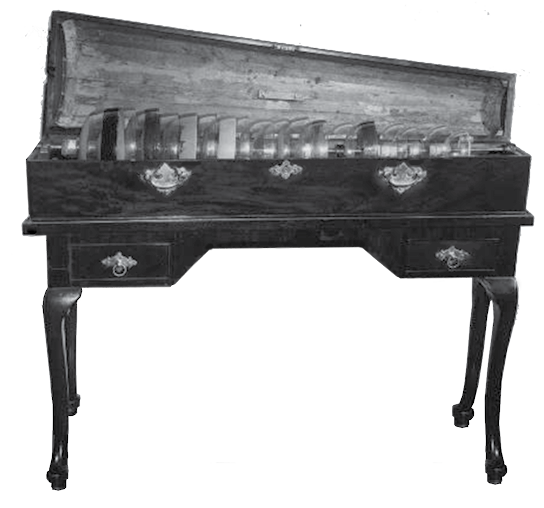
- Figure 28: Franklin's “London” armonica which Franklin had built there in 1761. The original foot treadle has been lost.
Further, in the biography prefixed to Sparks’s Works of Benjamin Franklin29 we read that the instruments were manufactured in London at the price of forty guineas.30
Apparently having James make his first instrument hadn’t gone smoothly, because when Franklin went back to the Cockpit Glasshouse to build another instrument, he asked for another glassblower. A Mr. Barnes was selected to try his hand, and he provided Franklin an “improved version” of the glasses, which were worthless for Franklin’s purposes. Meanwhile, in June 1762, James went into business for himself. He took out an ad in the London Journal,31 in which he called himself “the maker who has been employed by the gentleman who is the real inventor, in the first ever made in England, and continues to be honored with his approbation.”32
Franklin was unhappy with the situation, but was consumed with his impending departure for the Colonies (Sept. 1762) and had no time to correct it. Writing to Polly Stevenson from Philadelphia, March 25, 1763, he expressed frustrations with James:
I am vex’d with Mr. James that he has been so dilatory in Mr. Maddison’s armonica. I was unlucky in both the workman that I permitted to undertake making those instruments. The first was fanciful, and could never work to the purpose, because he was ever conceiving some new Improvement that answer’d no end: the other is absolutely idle. I have recommended a number to him from hence, but must stop my hand.33
Meanwhile, when Franklin's colonial colleague Thomas Jefferson was in Paris in 1787, he inquired of John Trumbull in London about “the price of a good harmonica, the glasses fixed on an axis, to comprehend 6 octaves...in a plain mahogany case.”34
Trumbull replied:
I am told the harmonica is never made to exceed three octaves. For one of that kind Longman & Brodsip ask me thirty guineas. I will enquire further on this subject.35
Which would seem to suggest that Longman & Brodsip were stepping into the gap left by Charles James.
Nevertheless, nothing Franklin wrote between 1757 and 1762, no experiment he undertook and carried out, absorbed him more happily than his musical invention.36 And apparently his daughter Sally learned to play as well, as a portrait of her playing the armonica was painted. Unfortunately, the painting has never been found.37
The Armonica: Franklin’s Lifelong Companion
Franklin was doubtless proficient on his own instrument, “and often may have spent his leisure hours with playing on it Italian music of the ‘soft and plaintive kind’.”38 Thomas Penn reports to James Hamilton, Governor of Pennsylvania on April 13, 1761:
I believe he [Franklin] has spent most of his time in philosophical, and especially in electrical matters, having generally company in a morning to see those experiments, and musical performances on glasses, where any one that knows him carries his friends.39
Upon his return to Philadelphia, Franklin put his armonica to use in a delicate family matter: Before Franklin and his son William left for London in 1757, William had proposed to Elizabeth Graeme and she had accepted. (Franklin and Elizabeth's father were on opposite sides of the political fence, and neither father approved of the marriage.) But William returned to the American colonies in 1762 a married man (to Elizabeth Downes, daughter of a wealthy Barbados sugar planter).40 Elizabeth’s mother Ann Graeme called on Franklin, father of the faithless groom — likely a very disagreeable conversation. But Franklin played his armonica for her, which appears to have calmed matters considerably. In a letter dated Dec. 3, 1762, from Mrs. Ann Graeme to her daughter Elizabeth, she explains how she had called upon the Franklins the day before, and “we appear’d to have a very easy afternoon,” and at Mrs. Graeme's request Franklin gave her “a tune on the harmonica.”41
Considering the state of glass making in the Colonies, it’s unlikely that Franklin had another instrument made by American craftsmen when he returned to Philadelphia in 1762. This is confirmed by ongoing correspondence we have of him trying to get armonica glasses from London.42 Thus it would seem that Franklin brought his London-made armonica with him to Philadelphia. At the same time, Marianne Davies has an instrument with which she started concertizing right away which suggests that Franklin had a second instrument made in London.
The jewel of Franklin’s house in Philadelphia was the music room, called the “blue room,” on the third floor. Graced with gilt carvings, an ornamental fireplace, and decorative chairs and screens, it featured Sally’s harpsichord and Franklin’s glass armonica. There he played duets with Sally on the harpsichord. Eventually the music room would boast a welsh harp, a bell harp, tuned bells, and a viola da gamba, all much used by his musical family.
When Franklin went to France in 1776 (the year the American colonies declared independence) he left his armonica behind in Philadelphia — perhaps because the ship on which he sailed was as small and fast as possible to evade the British blockade.43 (If the British had captured Franklin, he almost certainly would have been hung as a traitor.) On July 14, 1778 Franklin’s son-in-law Richard Bache reported on the state of his house following its occupation by a “rapacious” band of British soldiers. Even before listing the missing books and scientific equipment, Bache lamented that they had carried off “some of your musical instruments, viz: a welch harp, bell harp, the set of tuned bells which were in a box, viol de gambo, all the spare armonica glasses and one or two of the spare cases. You armonica is safe.”44
- Figure 29: Madame Brillon's Armonica in Paris
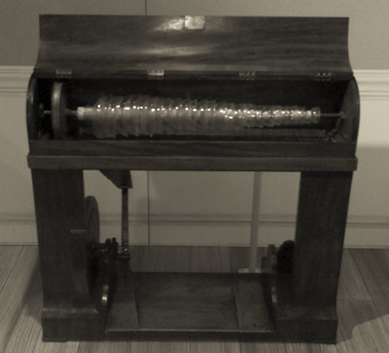
Meanwhile, we know that Franklin played the armonica for his friends in France. When he visited his friend Madame Brillon, an accomplished musician and composer, she would accompany Franklin and his armonica on the pianoforte. And Madame Brillon played the armonica herself.45 Abbé Morellet enlivened their gatherings (with Mesdames Helvétius & Brillon) singing in French Franklin’s favorite Scottish ballads while Franklin accompanied them on the armonica. For a dinner in honor of Franklin held sometime around Independence Day, the abby toasted him in a highly complementary song of his own composition with a heady refrain: “Le verre en main / Chantons nôtre Benjamin” (“With glass in hand / Sing to our Franklin.”).1
An inventory of Franklin’s instruments at the time of his death includes a viola da gamba, bells, harpsichord, glass armonica, spinet, Chinese gong, and a “Glassichord.” The reader will recall that the “glassichord” was the initial name that Franklin gave to the armonica. Yet, clearly if the armonica has already been listed in the inventory, the person listing the inventory wouldn’t have listed the same instrument with an additional name. Thus the glassichord must be a different musical instrument altogether. Therein lies a tale:
In the winter of 1784/85, a Parisian physician named Beyer approached Franklin with an idea for constructing a kind of glass xylophone, played by means of mechanical hammers controlled by a keyboard. Franklin must have been intrigued by the idea, and gave Beyer his endorsement. Beyer presented a prototype to the Académie des Sciences in the spring of 1785, and received an enthusiastic reception. He then reminded Franklin of his promise to give a name to what the inventor had been calling simply “the instrument.” Ever frugal, perhaps Franklin found a use for his formerly abandoned name and christened it the “glassichord” (or glasschord/glasscord). He purchased one to take home with him to Philadelphia. Jefferson saw the instrument a week before Franklin left France and found it charming. Its tone was exceptionally sweet, he said, and Jefferson only regretted that its three-octave range was too short.47
In 1804 an advertisement appears in Paris entitled “Advertisement for a Lightning Conductor, Invented and Made by Beyer, Physician,” engraved by by Laurent Guyot. Presumably the same person?
Franklin’s famous Autobiography ends in 1757 — three years short of his invention of the armonica. But we know from his outline for the rest of the book that he had planned on devoting a chapter to it.48
Glass ‘Armonica’ or ‘Harmonica’?
As we have seen, Franklin named his invention the ‘armonica’ after the Italian word for ‘harmony’ (‘armonia’). Reviewing the 19 letters in which Franklin mentions the armonica at all, he was consistent about calling it the ‘armonica’, the only exception being a reply to a letter from Count de Saluces dated July 5. 1785. The Count had written to Franklin in French, referring to the armonica as “l’harmonique”, and Franklin replied in English referring to it as “the Harmonica.”
Franklin's contemporaries, however, were quite arbitrary about referring to it as the ‘armonica’ vs. ‘harmonica’.
The better known mouth organ ‘harmonica’ first appeared in Vienna in the 1820s — some 60 years after Franklin coined the name ‘armonica’ for his own invention.
When Franklin's invention was embraced by German speaking countries its name was German-ized to ‘glasharmonika’ (with the added ‘h’). In the latter half of the 19th century the glass armonica all but disappeared. Glass armonica music was revived in the 20th century by another German, Bruno Hoffman (1913–1991). When he performed in English speaking countries he English-ized ‘glasharmonika’ back into ‘glass harmonica’.
Personally I prefer ‘glass armonica’ for two reasons: one is out of respect for its inventor and the perfectly good name he coined. The other is that calling it any sort of ‘harmonica’ just confuses it with the now better known mouth organ. People unacquainted with the instrument may think they know what a ‘glass Harmonica’ is, but the different spelling ‘glass Armonica’ at least gives a hint that it is something different.
Attempts at Improving Franklin’s Invention
Water Trough
A trough was sometimes placed beneath the row of glasses. Many sources assert that this was filled with water so the glasses would rotate into the water and remain constantly wet.49
As any armonica player can atest, however, keeping the glasses moist is simply not a problem. One good ‘dip’ at the beginning is sufficient for most pieces. For longer works like the Mozart armonica quintet (K617), there are more than enough places where the armonica rests while the rest of ensemble keeps playing — in these ‘rest’ intervals the armonica player has more than enough opportunity to remoisten the glasses — if needed. And the player also has the option of re-moistening the lower glasses with the left hand while the right hand keeps playing and vice versa.
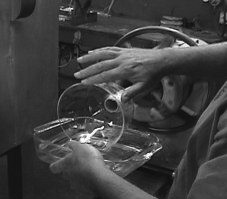
Singers figure out where to breathe, armonica players figure out where to dip — one of the easier aspects of playing the instrument. Nevertheless, non-armonica players frequently assume that keeping the glasses moist must be a ‘problem’ that they must solve for us. One frequently proposed solution is to have the glasses rotate through a trough of water.
So I tried it! I mounted an armonica glass made on a glass lathe, set the speed appropriately, and then lifted a basin of water to immerse the rim to various depths (see Figure 30).
And I discovered: rotating the glass into a trough of water has exactly the same effect as adding water to a wine glass — it lowers its pitch. And since each glass on a glass armonica is a different size, each glass will rotate into the trough with a different depth, and will consequently have its pitch altered by a different amount. In other words, rotating several dozen armonica glasses (on a typical armonica) into a trough of water will result in musical chaos.
This shouldn’t have been a surprise. If you’ll recall from our chapter on “The Singing Wine Glass for Dummies®,”50 water on either the inside or the outside lowers the pitch. The fact that in this case the wine glass is sideways instead of vertical doesn’t change that at all. (See Figure 31)

Furthermore, when the glass was rotating through the trough of water, it was much harder to play — the water dampened the sides of the glass and made it noticeably harder to make it speak because the glass was too wet.
The water trough also muffled the sound of the glass.
It might be suggested that armonica makers have the glasses appropriately out of tune so that when the trough is filled, they are put back in tune. I can only say that: As someone who has tuned a set of armonica glasses — they are difficult enough to tune as it is. The mind boggles at what would be necessary to pre-compensate for the effect of the water trough. The water level would have to be extraordinarily precise. And evaporation is then a significant problem. Now we’re right back to the water tuning hassle that Franklin was trying to avoid.
So let’s see now: in order to avoid having to dip once or twice in the course of a piece of music we’re going to:
- • Have the trouble of filling the trough to a very precise level and keep it there in spite of evaporation
- • The glasses will be more difficult to make speak
- • The glasses will sound muffled
- • Tuning will be very problematic at best
All of this to solve a ‘problem’ which was never a problem in the first place. In other words, the water trough is just one of those ‘good ideas’ that simply doesn’t work in practice.
There are indeed armonicas with troughs. Might I suggest that the real purpose of the empty trough was to catch the inevitable water drips? That would actually be useful!
Adding a Keyboard
We have already seen Anne Ford discussing adding a keyboard to the musical glasses. Another curious example of that is found in an advertisement for performances by H.B. Victor in the Pennsylvania Packet in 1774:
Mr. Victor, Musician to her late Royal Highness the Princess of Wales, and Organist at St. Georges in London, lately arrived here, takes this method of acquainting the Musical Gentry in general, that he gives instructions on the Harpsichord, or Forte Piano, Violin, German Flute, etc., especially in the thorough Bass both in theory and practice, for that his pupils may soon come to a fundamental knowledge of that fine science.
N.B.1 Mr. Victor intended to give a concert, and to perform on his new musical instruments, but is obliged to postpone it for want of able hands; the one he calls tromba doppia con Tympana, on which he plays the first and second trumpet and a pair of annexed kettle-drums with the feet all at once; the other is called cymbaline de amour, which resembles the musical glasses played by harpsichord keys [in other words, it has a keyboard], never subject to come out of tune, both of his own invention. He is to be met with at his house in Callow Hill street near Water street.51
Several other people tried to add a keyboard to the armonica as well.
Francis Hopkinson
One of these was Francis Hopkinson (1737–1791). Hopkinson was Franklin’s Philadelphia friend, and although 30 years his junior he only survived Franklin by a few months. He stood in the center of musical life in Philadelphia, as psalmodist, teacher, organist, harpsichordist, essayist, composer, and improviser on the harpsichord. He was a graduate of the first class to graduate from the College of Philadelphia, and a prominent patriot of the Revolutionary War, and a signer of the Declaration of Independence. He was admitted to the practice of law in 1761. He was also a bibliophile — a family tradition tells us that the Hessian officers were so impressed with the character and extent of his library in Bordentown that they did all in their power to save it from destruction. He also invented an improved candlestick and instrument to measure distances on the high seas. He was also a capable painter and caricaturist.52
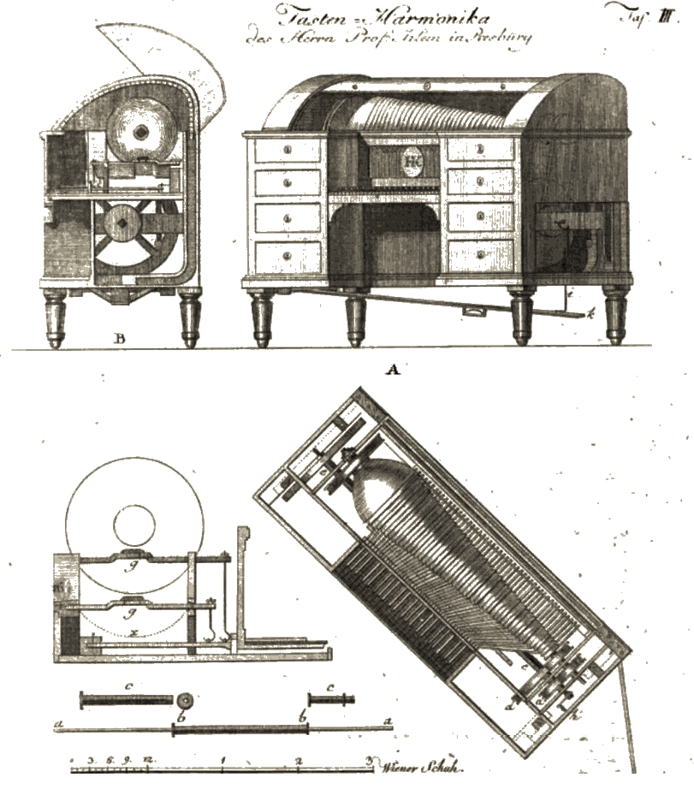
- Figure 32: A Keyboard Glass Armonica
AMZ July 1799
On 1786, June 28 he wrote from Philadelphia to Thomas Jefferson in Paris:
My spare time and attention is at present much engaged in a project to make the harmonica or musical glasses to be played with kees [keys], like an organ. I am now far forward in this scheme and have little doubt of success. It has in vain been attempted in France and England. It may therefore seem too adventurous in me to undertake it, but the door of experiment is open; in case of disappointment the projector is the only sufferer.
Jefferson replied on December 23, 1786:
I am very much pleased with your project on the harmonica, & the prospect of your succeeding in the application of keys to it. It will be the greatest present which has been made to the musical world this century, not excepting the pianoforte. If its tone approaches that given by the finger as nearly only as the harpsichord does that of the harp, it will be very valuable...
In a letter of April 14, 1787, from Philadelphia, Hopkinson wrote to Jefferson:
... I shall now begin again upon the harmonica. From the experiments I have made, I have no doubt of the success. I have already applied keys to the glasses, furnished with artificial fingers which answered perfectly & most delightfully in a great part of the scale. Where they did not succeed so well was owing to the glass not being truly mounted, so that I must, I find, take off the glasses from the spindel & mount them anew.
Hopkinson wrote again on July 8, 1787, from Philadelphia:
... I succeeded in making the harmonica to be played with kees [keys] as far as I believe the instrument is capable: — but required too much address in the manner of wetting the cushions for common use. In the course of my experiments I discover’d a method of drawing the tone from metal bells by friction — to an amazing perfection — without the necessity of water or any fluid. I am getting a set of bells cast, expect to introduce a new musical instrument — to be called the Bellarmonic.
But for all his optimism and Jefferson’s enthusiasm, neither this nor any other attempt to turn the armonica into a satisfactory keyboard instrument proved effective. No keyboard armonica seems to have survived, not even in a museum.53
Konrad Bartl
Franz Konrad Bartl (1750–1813), a Viennese professor of mathematics, also designed a keyboard glass armonica:
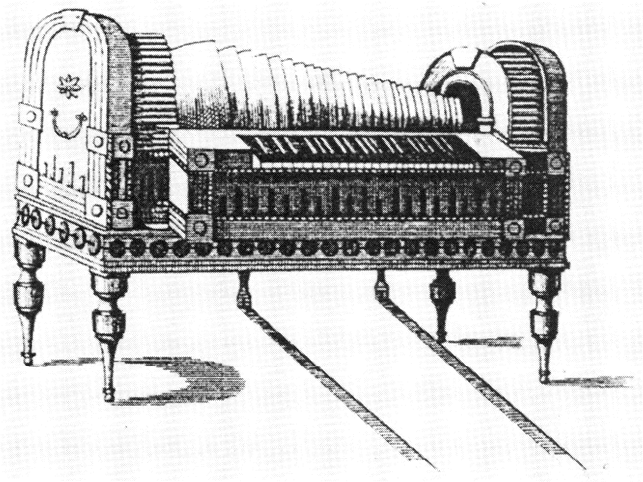
- Figure 33: Keyboard Glass Armonica by Franz Konrad Bartl (1798)
Abbé Perno
In 1785 the Count de Saluces in Turin wrote to Franklin announcing that his countryman Abbé Perno had invented a keyboard armonica. In his reply of July 5, 1785 Franklin himself summarizes the difficulties of accomplishing this:
When I was in London, about 12 years since, Mr. Steele, an ingenious musician there, made an attempt of that sort; but the tones were with difficulty produc’d by the touch from the keys, and the machinery in playing made so much noise and rattle, as to diminish greatly the pleasure given by the sound of the glasses; so that I think the instrument was never compleated. The Dutchess [of Villeroy] at Paris about the same time endeavour’d to obtain the same end, and has not yet laid aside the project, tho’ it has not hitherto perfectly succeeded. Baron Feriet of Versailles, began to work on the same idea about the time I receiv’d your letter; and as he is a very ingenious man, and has a hand to execute as well as a head to contrive the necessary machinery, I hoped soon to have given you an account of his success: but I begin to doubt it, as I hear nothing from him lately. In my manner of playing on my instrument the fingers are capable of touching with great delicacy; and the glasses turn so smoothly, that one hears no other sound but that given by the touch. If the instrument of Abbé Perno has the same advantages, its being play’d with keys gives it an undoubted preference, and I should be glad to know the construction.54
In 1802 Zink, of Hesse-Homberg, built a three manual [keyboard] “grand pianoforte” in which one manual was a glass armonica(!), another was a piano, and the third played several wind instruments.55
As Lütge observes, “the keyboard armonica did not succeed despite the playing advantages, because the ethereal, penetrating sound was impaired. One wants the thrill, which the fingertips draw from the glasses. One remains with Franklin’s armonica.”56
1 Note Bene: Latin for “note well”