9. The Armonica Waxes
So far we have been considering the role of individuals in the story of the musical glasses and glass armonica. Looking at the musical glasses and glass armonica from a more national perspective will round out our story.
The Armonica in England
The music glasses became quite popular in England. Jackson’s Oxford Journal for December 12th, 1761, contains the following:
The Young Gentleman who has performed on the Musical Glasses, by permission of the Vice-Chancellor, takes this method of returning thanks for the great encouragement and kind reception he has met with: and to give notice that this day ... will be positively the last of his performances at Oxford; and that early Monday morning he will set out for Bath, and purposes to stop that day at the New Inn at Abindgdon for the entertainment of the Ladies and Gentlemen of that town.
They were mentioned in Oliver Goldsmith’s popular novel of the day The Vicar of Wakefield (1761):
They would talk of nothing but high life, and high-lived company; with other fashionable topics, such as pictures, taste, Shakespeare and the musical glasses.1
As we have seen, Marianne Davies performed on the armonica throughout Great Britain from early 1762 to 1764, and in London from June 1767 to fall 1768. She seems to have returned to England around 1797 — she doesn’t appear to have performed any more. Schumann and Largeau were two other armonica players who performed in London from 1762–1767 — almost nothing is known of them.2
In 1778 Frick arrived in London and apparently performed until around 1795 (when he experienced his spiritual conversion).
Kirchgessner arrived in London in 1794 and performed until 1796, after which she left for the Continent.
In 1785 we have a poem by British poet William Hayley about the armonica:
Woman, I say, or dame or lass,
Is an Harmonica of glass,
Celestial and complete:
If new, or by some trials known,
It matters not
A single jot:
When rightly touch’d, its every tone
is ravishingly sweet.3
In Samuel Coleridge’s play Remorse (1812), the beginning of Act III is set in an underground crypt with a sorcerer, and the script indicates “soft music from an instrument of glass or steel.”4
In 1818 Samuel Coleridge writes in The Friend:
A true musical taste is soon dissatisfied with the harmonica, or any similar instrument of glass or steel, because the body of the sound (as the Italians phrase it), or that effect which is derived from the materials, encroaches too far on the effect from the proportions of the notes, or that which is given to music by the mind.5
I’m not sure I understand what he means (the rest of the essay isn’t much help), but it’s certainly clear he doesn’t care for it!
I haven’t found any further mention of glass armonica performances in England in the early 19th century — did the fact that it was invented by the British traitor Benjamin Franklin have something to do with that? Meanwhile, performances on the musical glasses in variety shows are frequent.
The Armonica in Italy
Franklin wrote to Beccaria in July of 1762 describing his new musical invention, which he had renamed to the new Italian name ‘armonica’. Franklin’s long-time correspondence with Beccaria rarely diverged from scientific and personal matters, so Franklin’s long description of the armonica is rather out of character. We surmised that Franklin believed Beccaria, who had so effectively championed his ideas about electricity throughout Europe, would prove an equal champion for his new musical invention. Franklin was not yet very well known in Europe, so he didn’t have a long list of options.
[Franklin] was convinced that the armonica was an important addition to the family of musical instruments, and that it was destined perhaps to supersede the harpsichord and piano. Hence, as previously with his stove and lightning rod, he must have been anxious to see humanity blessed with the new invention as soon as possible. That intent could obviously be no better served than by having his instrument adopted and cultivated in the land that was the musical Mecca to which the western world still turned for diversion and instruction. What then more logical than for him to dedicate his new instrument to a prominent Italian in order to take advantage of Italy’s musical hegemony? An Italian name for the invention, along with a national compliment or two for good measure, was probably calculated to contribute further to put the Italians in a receptive mood.6
If that was Franklin’s plan, it didn’t work. Beccaria was interested in literature, painting and sculpture — but not music. Consequently, Franklin’s letter of 1762 was not published in Italy until 1769, and only then due to the efforts of the distinguished historian and Latinist Baron Guiseppe Vernazza. It wasn’t printed again until the mid 1770s, exhumed presumably due to the concertizing of Marianne Davies, who arrived in Italy with her sister in late 1770/early 1771.
In 1772 Beccaria published a revised and expanded edition of his celebrated On Natural and Artificial Electricity. On May 20, 1771 Beccaria finally replied to Franklin's letter of July 1762 regarding the armonica, and included this letter in his preface:
I thank you, distinguished Sir, for the exact description of your new and truly harmonious crystal clavichord (thus it is granted you to illumine the mind of man with the principles of the new electrical science, to reassure his spirit against the horror of strokes with your [lightning] conductors, and to soothe his senses with sweet and pathetic music); and if I were capable, I would thank you in the name of our Italy for having, as you say, given your worthy instrument the name of Armonica precisely because of our harmonious language....7
The relevance of the glass armonica to artificial electricity is far from obvious. But Franklin’s description of the armonica had recently been published in English, and translated into Italian (both in 17698), the armonica was in the public eye thanks to Marianne Davies, and Beccaria may well have wanted to use his connection with the increasingly famous inventor to promote his new edition.
The correspondence between the two Milanese brothers Counts Pietro and Alessandro Verri in the end of the eighteenth century gives us another window into the history of the armonica in Italy. English travelers had brought musical glasses to Italy before Franklin’s letter to Beccaria, and Pietro Verri, charmed by the sound, experimented with them himself. He had over one hundred glasses made and amused himself by playing simple tunes. But he wasn’t happy with the results, because he could only play two notes at a time, and because the water tuning was not only troublesome but interfered with the timbre and resonance.9
One can thus easily imagine Pietro’s excitement on hearing of the armonica from his brother Alessandro who was traveling in London. Alessandro’s letters of recommendation and personal qualities gained him immediate access to London’s most exclusive society during the three months he spent in England. Of course he had to visit Franklin, who had returned to London in 1764. And we find Alessandro writing home to his brother on January 27, 1764:
I have been to see the Newton of electricity, the famous Franklin. He is a man of over fifty years of age. You know that by pressing and sliding a moistened finger over the edge of a glass a sound is produced. He has made the instrument on this principle. He has strung on a spindle, or common axis, as many glass bells as correspond to the pegs of a harpsichord, proportionately graduated. The spindle turns by means of the left foot, with a wheel, as the knife grinder does. At the same time one touches with the fingers, as one does a harpsichord the bells which spin like wheels, after having first wet them slightly with a sponge. A melody comes out which goes to the heart.10
A year and a half later Pietro writes that he is determined to own an armonica. English general Henry Humphrey Evans Lloyd had paid him a visit in early 1768 and returned to England. Pietro writes:
Lloyd is having sent to me from London an armonica, which is the instrument that you saw at Franklin’s. Within a month it should be at Genoa. He tells me that the basses are so powerful that they make the air vibrate and the windows of the room tremble. Tell me if you found it so. This winter an Englishman has been with us who played on the glasses, but it was not the device of the armonica. There were thirty-two glasses fixed motionless on a table and with a determined amount of water. By rubbing the fingers over them, a rather pleasing sound was produced. The chiaroscuro and expression are superb. There is no brilliancy, but there is the most touching passion, and I was enchanted with it. If the armonica produces a similar effect, I shall be satisfied.11
Alessandro replied promptly:
The London armonica must be precisely the one that I saw at Franklin’s. It seemed delightful to me. There are a number of graduated glass bowls strung on an axle which, placed in horizontal position, is spun with a pedal. One moistens his hands with a sponge and plays as on the keys of a harpsichord. The Marquise has also heard the instrument with the thirty glasses and says that at first she was ravished with delight, and finally she was bored. I believe that this is so because it does not sustain the tone, and, after the strokes, the sounds continue and become confused. There are none of these inconveniences in the armonica. Franklin played only a rather simple minuet for me, but I liked it very much. What charmed me was to hear a sweet and aerial sound without being able to determine the place it came from, because there is no striking of strings, nor hiss of breath, which in other instruments determine the seat of the sound and make it harsh. This is a human voice, but of greater mellowness and sweetness. I hope that you will get much pleasure from it.12
Poor Pietro couldn’t know that he was destined to never have an armonica. By the end of 1771 he had concluded that Lloyd had forgotten his promise. Marianne Davies’ visit to Milan at about this time must have fueled his desire and frustration. His remark “At the present time there is an Englishwoman who plays it; it’s heavenly” must refer to Marianne Davies.
Obviously inspired by Marianne Davies, Pietro made one more attempt, this time through his brother who had connections in England. In December, 1771 Alessandro commissioned his London agent to furnish an armonica, but he warned Pietro that no merchandise had ever reached him from London in less than eight months. In January 1772 Alessandro reported that a friend of his “just come from London had seen the armonica played by poor women circulating about the cafes, and on such evidence assured his brother that the instrument could not be very expensive.”13 In February, Alessandro’s London agent informed that he would talk with Franklin immediately about an armonica for Pietro. Alas, a month later the London agent reported:
We went to the workman who made several of the well known armonicas for this Dr. Franklin, the inventor, but he said that he is so weary of that work that he would not undertake another at any price. Hence there remains only to whether there is in London some other mechanic capable of such things.14
Pietro’s reply shows that he has come to appreciate the difficulties involved in constructing a good armonica, and has resigned himself to the likelihood that he shall never obtain one: “It will take patience; and if an armonica is found, it will be something more than I expect. Dear Sandrino, I thank you for the trouble that you have taken.”
After this, there is no further discussion of the armonica in the correspondence of the two brothers.
Scattered fragments of information remain concerning the fortune of the armonica in Italy:
Around 1772 the Milanese nobleman Count Lodovico Barbiano di Belgioioso, then retired to London after a strenuous military and political career in the service of Austria, wrote to Franklin to obtain the address of the workman who made glasses for the armonica so he can make one for the French ambassador.15
In 1790 the anonymous author of the Roman Anthology wrote:
... all those who have heard it played confess that it is the most attractive, the most melodious, the most dramatic [instrument] hitherto conceived, and that, with its tragic, penetrating, and pure sounds, and its sweet and harmonious concents [sic] that can be at pleasure maintained, strengthened, and made to die away imperceptibly, it is more capable than any other instrument of moving, charming, and seducing souls and of making them fall into the most delicious reverie.16
The Armonica in France
In the mid-eighteenth century there had been a concerted effort among the philosophes in France to combat ignorance and superstition by gathering together every scrap of known scientific knowledge and publishing it. One of these efforts was a 35-volume landmark Encyclopédie edited by Denis Diderot and Jean d’Alembert (appearing in installments from 1751 to 1780). The musical glasses were sufficiently popular to receive an entry “Verres, musique des” (quoted here in full):
Glasses, musical, (Arts) For many years one has imagined producing, with the help of glasses, a new type of harmony, very pleasing to the ear.
It is claimed that it is an Englishman named Puckeridge who is the inventor; however this method was known for a long time in Germany. The instrument which is useful for this effect is an oblong rectangular box, in which are arranged & fixed several round glasses of different diameters, in which one puts water in various quantities. While rubbing with the wet finger on the edges of these glasses which are a little oblique, one draws from them very soft, very melodious & very constant sounds; & one can play extremely pleasant airs in this manner.
The Persians have for a long time had a very similar way of producing sounds; it is while striking with small sticks seven porcelain cups filled with a certain quantity of water, which produces harmonies.17
As we have seen, Marianne Davies performed in Paris in 1766,18 which would appear to be France’s introduction to this instrument. 1778 found the Davies sisters in Paris, but Marianne appears to be plagued by ‘ill health’ and may not have performed.
Kirchgessner never performed in France.
Mesmer arrived in Paris with his armonica in 1778. Mesmer didn’t give public performances on his armonica, but it was a prominent feature of his well-known ‘animal magnetism’ treatments. Mesmer left Paris in 1785 and returned briefly in l801.
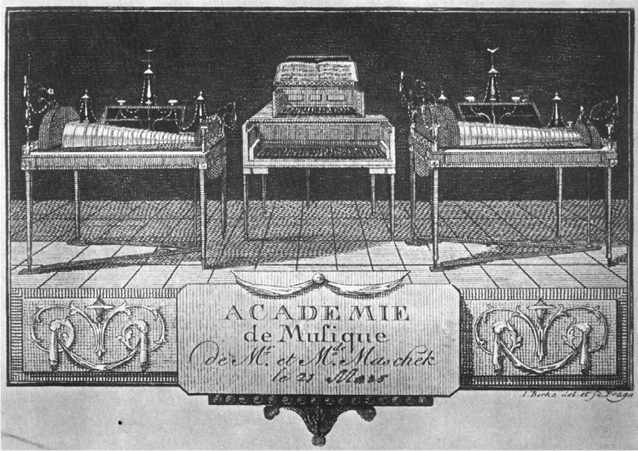
- Figure 42: Detail of a poster for a concert by Mr. & Mrs. Mašek
presented by the Académie de Musique, March 23, 1791
Robertson opened his Phantasmagoria in Paris in 1798; they continued until he left Paris in 1803.
In 1799, Anne Louise Germaine de Staël-Holstein (1766–1817), commonly known as Madame de Staël, a French woman of letters, wrote in her book De la Littérature (“On Literature”):
Melancholy poetry is not capable of infinite variety. The shudder we feel at certain natural beauties is always the same feeling; the emotion that the poetry retracing this feeling inspires in us is very close to the effect of the armonica. The soul, gently shaken, takes pleasure in prolonging this condition as long as it can bear it. What makes us feel tired after a while is not the poetry’s fault, but the weakness of our own organs; what we feel is not bored, but exhausted, as if by aerial music which we have been enjoying a little too long.19
Later, while visiting Germany, Madame de Staël wrote to her father: “I have taken two armonica lessons; if I manage to play, I’ll buy one in Paris, but not here. It's expensive and fragile.”20
In 1826 the famous French politician, diplomat, writer and historian François-René Chateaubriand (1768–1848) published Les Natchez, in which he describes heaven as a wonderland of music:
Music never ceases in these places: music which one hears everywhere, but which is nowhere; sometimes it is a murmuring like that of an Aeolian harp which the soft breath of Zephyr strokes on a night in springtime; sometimes the ear of a mortal believes it hears the plaint of a divine harmonica, those vibrations which have nothing terrestrial about them and which swim in the middle region of the air.21
Chateubriand mentions the armonica in two later novels. In Vie de Rancé (1844, “Life of Rancé”) the melancholy penitence of the Christian hermit Rancé is compared to “a voice at the bottom of the sea, like the sounds of the armonica, born of water and crystal, and that hurt,”22 and in the Mémoires d’outre-tombe (1848, “Memoires from beyond the Grave”) his adolescent self conjures up his imaginary lover [la sylphide] from the ‘liquid sounds’ of the glass armonica.23
Franz Liszt (1811–1886) in his biography The Life of Chopin (1863), writing of his colleague and friend Frederic Chopin (1810–1849) describes him playing in his apartment, comparing it to the armonica:
His apartment, invaded by surprise, was only lighted by some wax candles, grouped round one of Pleyel’s pianos, which he particularly liked for their slightly veiled, yet silvery sonorousness, and easy touch, permitting him to elicit tones which one might think proceeded from one of those harmonicas of which romantic Germany has preserved the monopoly, and which were so ingeniously constructed by its ancient masters, by the union of crystal and water.24
George Sand (1804–1876), Chopin’s long-time lover, gave the armonica a brief appearance in her novel La Comtesse de Rudolstadt (1856). In her novel, the heroine Consuelo, in Vienna, wakes up to find herself in prison. She is rescued, only to be subjected to a Masonic-like ritual of initiation in which the armonica plays a role. Notice the extraordinary footnote Sand includes to explain the armonica to the reader:
In this moment the doors of the temple opened with a metallic noise, and the Unseen Ones entered two by two. The magical voice of the armonica, that recently invented instrument(13), whose vibrant, penetrating quality was a wonder unknown to Consuelo’s ears, was borne on the air, and seemed to go down from the dome that lay open to the moonlight and the refreshing breezes of the night....
(Note 13: Everyone knows that the armonica created such a sensation with its appearance in Germany, that the imaginations of poets heard in it supernatural voices, evoked by the celebrants of certain mysteries. For some time this instrument, considered magic before it became popular, was raised by the practitioners of German theosophy to the same divine honor as the lyre among the ancients, and as many other musical instruments among primitive people of the Himalayas. From the armonica they evoked one of the hieroglyphic figures in their mysterious iconography, representing it in the form of a fantastic dream. Neophytes in secret societies, hearing it for the first time after the terrors and emotions of their harsh initiations, were so deeply affected by it that several fell into ecstasy. They believed they heard the song of the invisible powers, because the player and the instrument were carefully hidden from them. There are some very curious details on the extraordinary role of the armonica in the initiation ceremonies of Illumination.)25
The Armonica in Germany
Though the armonica was invented in England by Benjamin Franklin, it’s really in Germany that it found its home — embraced and loved like nowhere else. That is still arguably true today: The massive music encyclopedia in German is Die Musik in Geschichte und Gegenwart (“Music Past and Present,” aka MGG) in 29 volumes, and the massive music encyclopedia in English is Groves Dictionary of Music and Musicians (2001, aka Groves) also in 29 volumes. In the German MGG the article on the “glasharmonika” is eight pages, but in the English Groves the article on the “armonica” is one paragraph!26
Meanwhile...
1766: The armonica is described in the Hanoversche Magazin27 and Leipzig’s Wöchentliche Nachrichten und Anmerkungen die Musik (“Weekly News & Notes on Music”).28
1768: Marianne Davies performs in Vienna.
1769: Frick tours throughout Germany. He gives a concert in Frankfurt on September 16 which includes this description of his instrument: “This instrument consists of pure glass bells, from which one hears a fine and singing tone unlike anything else in music.”29
1773: Frick tours Germany again, Hamburg in February, and leaves for Russia.
1776 or 1777: Frick returns to Germany from Russia.
1778: Frick leaves for London.
1780: Rollig takes up the armonica and goes on tour.
1781: Rollig performs in Hamburg.
1782: The Almanach für Deutschland auf das Jahr 1782 (“Almanac for Germany for the year 1782”) announces Franklin’s new invention:30
Of all musical inventions, the one of Mr. Franklin has created perhaps the greatest excitement. Concerning the way of producing tones, it is an entirely new kind of instrument. But considering the remaining aspects, it has similarities to the glockenspiel, the electrical machine, and the so-called ‘Nuremburg Geigenwerk’.31
The article proceeds to argue that the armonica badly needs a keyboard — perhaps using India rubber fingers. It also describes an Abbot Mazzuchi who plays with two violin bows, and has experimented with bells made of metal and wood(!).32 The article also mentions Frick and Rollig as two current armoncia virtuosi.
1787: Rollig’s Über Die Harmonika: Ein Fragment (“Concerning the Armonica: A Fragment”).
1788: Rollig performs in Hamburg.
1791: Kirchgessner performs in Vienna; Mozart composes for her his Adagio for armonica solo (K617a), and the Adagio & Rondo for armonica, flute, oboe, viola and cello (K617). Rollig moves to Vienna.
1792: Kirchgessner performs in Prague, Dresden, Leipzig, Berlin, Hamburg and Magdeburg.
1796: In November/December Kirchgessner performs in Hamburg.
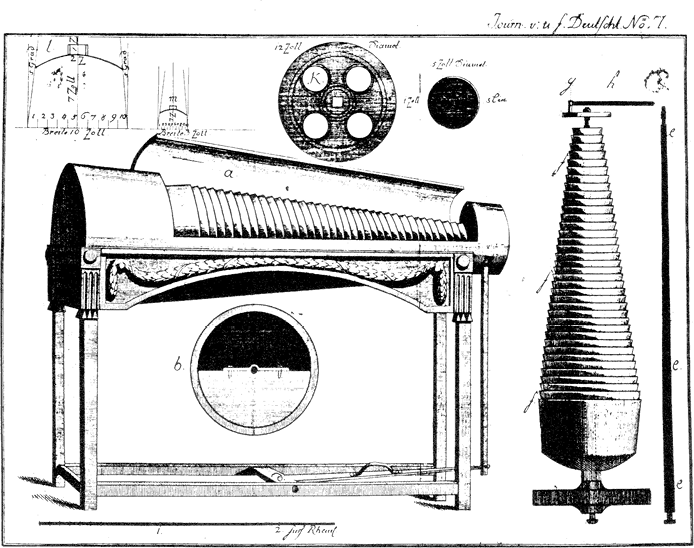
- Figure 43: Schematic diagram of a glass armonica, from the
Journal von und für Deutschland 1784, Heft Nr. 7, Julius
1800: F.F. Hurka (1762–1805) a minor musician of Bohemian origin, a tenor singer in various towns and concert director in Berlin, includes a song about the armonica in a collection published around 1800. The song is entitled “An die Harmonika,” a setting of words by ‘Richter’ (probably Jean-Paul Richter). The first and second of the six stanzas are as follows:
Youngest and fairest of the fair daughters of sweet harmony, to whom that mother gave omnipotence in magical sounds, thou, sent to comfort mortals whom the goddess saw lamenting, were turned aside from Elysium and did become — ‘Harmonika’. When first every ear hearkened to the new sound, all the sons of earth abandoned themselves to enchantment: their intoxicated spirit seemed to hear the harmony of the spheres and the song of the angels in praise of the Uncreated.33
Jean Paul in his novel Titan (1800–03) writes:
The zephyr of sound, the harmonica, drifted sighingly over the garden blossom ... and the notes cradled themselves in the thin lilies of the waking water so that the silver lilies burst for joy and sun into flame-like blossom... Could you, Albano, keep happiness and sorrow hidden in your heart if you heard such a gentle virgin passing in the musical moonlight?34
1801: Kirchgessner performs in Hanover and Frankfurt.
1804: Kirchgessner performs in Leipzig. Rollig dies in Vienna.
1805: Kirchgessner performs in Berlin and Breslau.
1806: Kirchgessner performs in Vienna.
1808: Kirchgessner performs in Prague; Kirchgessner & Goethe meet.
1809: Kirchgessner performs in Stuttgart, dies in Schaffhauser.
1812: Pohl records a concert given at Berlin which includes a trio for three armonicas! Sadly, it ended badly:
Difficult as it is to find two Harmonicas which accord well together [in tune with each other], the difficulty is greatly augmented to find three instruments which agree well — in fact, such is very seldom to be found. The artist had borrowed the third Harmonica of a private gentleman, who valued it so highly that he was only by urgent entreaty induced to part with it for one evening. The concert was attended by a crowded and delighted audience, and is thus mentioned (Berlin, February 9, 1829): “The perfectly assimilating execution, and the pure intonation throughout of all three harmonicas, conveyed to the hearer the idea that but one instrument was played.” The more it must have been terrible to the artist, when, at the end of the evening so successfully past, the very instrument which had been with such entreaty obtained, fell to the ground through the carelessness of the porters; all the glass bells were broken, and thus the truly happy result of the evening was destroyed in the most painful manner.35
In 1813 the music critic and gothic author E.T.A. Hoffmann published a review of Beethoven’s piano trios, Op. 70 (the first trio is known as “The Ghost”) in which he says of a certain passage:
If these sextuplets are played with a dexterous light touch with the soft pedal down and the dampers raised, a susurration is produced that recalls the aeolian harp and the glass harmonica and has a quite wonderful effect when combined with the bowed notes of the other instruments.36
To the soft pedal and the sustain pedal the reviewer added the so-called harmonica pedal. The Germans added a pedal to their pianos called the “String Harmonica” or the “Harmonica Keyboard Glide” — the keyboard would slide over a tiny amount that resulted in only two of the three strings being struck by the piano (the third would sympathetically vibrate), making the sound quieter and more ethereal. It’s still present on modern grand pianos, except that the hammer now strikes only one of the three strings when the pedal is depressed — it’s now called the “una corda” (“one string”) pedal.37
1815: Beethoven composes his Melodrama for the glass armonica.
1819: E.T.A. Hoffmann publishes a gothic short story Die Automate (“The Automata”). The story concerns an automata — a ‘mechanical man’ (very popular in those days) who is constructed and clothed to look like a Turk. The audience poses questions to the Turk, and he replies with uncanny answers and prophecies which “read the very soul of the questioner.” Our protagonist Ferdinand asks the Turk about his secret long lost love, and the Turk replies: “Unhappy man! At the very moment when next you see her, you will be lost to her forever!” This upsets Ferdinand terribly, so he and his friend Lewis visit the maker of the Turk, Professor X. The Professor conducts an eerie performance of an orchestra of mechanical musicians. Ferdinand and Lewis leave, and discuss the difference between soul-less mechanical music and the music that springs from Nature. Lewis explains:
There is, about the imperceptible commencement, the swelling and the gradual dying of those nature tones — something which has a most powerful and indescribable effect upon us; and any instrument which should be capable of producing this would, no doubt, affect us in a similar way. So that I think the glass harmonica comes the nearest, as regards its tone, to that perfection, which is to be measured by its influence on our minds. And it is fortunate that this instrument (which chances to be the very one which imitates those nature tones with such exactitude) happens to be just the very one which is incapable of lending itself to frivolity or ostentation, but exhibits its characteristic qualities in the purest of simplicity.
Their conversation is interrupted by a woman singing the favorite song of Ferdinand’s long lost love, accompanied by a glass armonica. Can it be she?
Just at this moment there suddenly came floating through the air an extraordinary sound, which, as it swelled and became more distinguishable, seemed to resemble the tone of a glass harmonica. Lewis and Ferdinand stood rooted to the spot in amazement, not unmixed with awe; the tones took the form of a profoundly sorrowful melody sung by a female voice.
They follow her, and
in every direction crystal tones came scintillating out of the dark bushes and trees, and streaming through the air like flame, united in a wondrous concert, penetrating the inmost heart, and waking in the soul the most rapturuous emotions of a higher world.
(I shan’t tell you the uncanny ending of the story!)
Also in 1819 a letter by Kapellmeister Johannes Kreisler appears in Der Freimüthige (“The Plain-spoken”).38 First he discusses why the armonica is going out of fashion, and of the cause of all the ‘fainting-spells’ the armonica causes:
Haude and Spener, in No. 31 of their journal [Berlinische Nachrichten von Staats- und gelehrten Sachen, March 13 1819] make it clear that Frau K[rickeberg]’s armonica playing was rather lacking in effect, and ask how it is that the armonica in general is no longer so effective as formerly; perhaps our nerves have become hardened or softened, or perhaps the fault lies in our ear-drums, now that they have been spoiled by all the drum-beating, trumpeting, tromboning, and keyed-bugling. On the other hand the Freimüthige für Deutschland, in No. 62 of that journal,39 calls the armonica the most beautiful and sonorous of all instruments, and praises the inspired fingers of this gifted artist which summoned forth the instrument’s ethereal echoes. I for my part, not having heard these ethereal echoes, must agree with Messrs. Haude and Spener that the astonishingly magical effect produced by the armonica years ago is now completely a thing of the past. But I am sure that our nerves have remained exactly the same, and that our eardrums, however battered they may be by drums and trumpets, are certainly still able to detect ethereal echoes too....
Now if the Freimüthige für Deutschland calls the armonica the most beautiful and sonorous of all instruments, then as a hardened musician I would reply that from the musical point of view the armonica is one of the most feeble and imperfect instruments there are! Of the welter of trivial ariettas and variations and polonaises and other insipid trifles that are normally played on it I will say nothing except to remark that, to a finer ear at least, any melody on the armonica sounds stiff and awkward. The fault lies in the instrument’s mechanism, which makes it impossible even for the most practised player to connect the notes together in an artistic sense. This mechanism also precludes any rapid execution. On the other hand, the armonica affords the advantage of the organ, that the note continues as long as one’s finger touches the glass. This property means that the characteristic quality of the instrument can be fully exploited only in slow music written in strict style.
Interestingly, swooning at the sound of the glass armonica seems to have been a method for women to attract men:
Now if it is true that the armonica has such limited capabilities in music, then it is clear that the admiration and wonderment created by its novelty was aroused merely by its tone... In addition, the armonica’s popularity rose during the period of delicate nerves, and when it was claimed that the armonica exerted a magical influence on the nerves, the instrument could not fail to captivate every sensitive soul. For any young lady of breeding it would have been most ill advised, as soon as the glasses were even touched, not to fall into a tolerably convincing swoon; she would have risked becoming an immediate object of indifference to any young man of refinement, however long he had courted her with amorous glances. Even ladies of more mature age fancied themselves transported back ten or fifteen years by all the pangs of blessed rapture, and received a heart and a novelette in the bargain! Of the use made of the instruments by Mesmer I prefer not to think! Now, it seems, the age of delicate nerves and swoons is just about over.
He concludes with a story worthy of Rollig:
The best armonica player of recent times I have heard was a fine man of gentle and pleasing character who, returning home from the French war, resided for a few days in the same house as me. I am referring to none other than my inestimable friend, the Bashkirian Colonel Tetulow Pripop who, unjustly, has become little known in the musical world. This man was totally obsessed by the armonica which he found in my house; he played the whole day long, and was able to elicit from the instrument the strangest sounds on could ever hear; the melodies and chords he produced also rejoiced in the most amazing originality. The distinctive, inimitable sound which other good armonica players achieve only now and then, and which insensitive people claim to resemble the scraping of a knife across a window-pane, was so completely within the colonel’s power that he was able to produce it uninterruptedly.
The manservant to my dear Tetulow Pripop, a jolly young fellow with a most endearingly tigerish physiognomy, was so beside himself at his master’s virtuosity that with loud howls he threw himself down and kissed his feet. Yet it was not surprising that this person was so deeply moved, since he too was musically gifted and was able, when playing his long, narrow, Bashkirian pipe, to awaken truly idyllic sensations in the breast. One was momentarily transported to the most beautiful toad-pond beside which a sensitive soul had ever sat. I will eternally remember the occasion when Tetulow Pripop played the armonica for the last time. Overcome by profound emotion, he had removed his large, pointed fox-fur capas as well as three small caps he was wearing beneath it; he sat there in his red cape, conjuring forth the most exquisitely ethereal harmonies, at which his tiger was also moved to wail and moan dreadfully.
Finally, as though in heart-breaking grief at the departure of their beloved friend, the majority of the glasses burst into pieces.
Thereupon the Bashkirian Colonel Tetulow Pripop pulled on a pair of white kid-gloves and hurried away to his regiment. I have never seen the good man since.40
Friedrich Schiller (1759–1805), author of the text for Beethoven’s “Ode to Joy”) may have been referring to the glass armonica in his novel Der Geisterseher (“The Ghost Seer”), published in installments 1787 to 1789. At one point in the novel preparations are being made to summon a ghost:
Having obtained the consent of the family, the third day was fixed on for the operation. I prepared them for the solemn transaction by mystical instruction, by fasting, solitude, and prayers, which I ordered to be continued till late in the night. Much use was also made of a certain musical instrument, unknown till that time, and which, in such cases, has often been found very powerful.41
And in one of his letters Schiller wrote about the armonica: “The effect of this instrument can be powerful in certain situations. I expect high inspiration from it.”42
The Armonica In America
Stephen Forrage gave a performance on Dec. 31, 1764 “for the benefit of Mr. Forrage and others, assistant performers at the Subscription Concert,” including a performance on Franklin’s “famous armonica, or musical glasses, so much admired for their great sweetness and delicacy of its tone.”43
Robert Carter & Peter Pelham
The landed gentry of Virginia, always well informed about the latest trends in Europe, showed an early interest in the glass armonica. Robert Carter III (1727/28–1804), probably the richest man in the colony and an avid musician, owned the only known glass armonica in Williamsburg. Carter ordered one of the new instruments in 1764 without ever having heard it. But he had heard about it from Bruton Parish Church’s organist Peter Pelham.
Pelham was an accomplished musician, apparently having studied for nine years with Karl Theodorus Pachelbel, son of the famous Johann Pachelbel. Opportunities for musicians in colonial America were few: Pelham supplemented his meager music income by running the town jail.Nevertheless:
Mr. Pelham of this place is just returned from New York, he heard on that journey Mr. B. Franklin of Phila[delphia]: perform upon the armonica: The instrument pleased Pelham amazingly and by his advice I now apply to you, to send me an armonica (as played on by Miss Davies at the great room in Spring Garden), being the musical glasses without water, framed into a complete instrument, capable of thorough bass, and never out of tune. Charles James of Purpoole [?] Lane, near Gray's Inn, London, is the only maker of the Armonica in England. Let the glasses be clear crystal and not stained, for whatever distinction of color may be thought necessary to facilitate the performance may be made here. The greatest accuracy imaginable must be observed in tuning the instrument, and directions procured for griding the glasses. They must be packed with great care, for if a glass should be broke the instrument will be rendered useless until the accident could be repaired from London. The case or frame in which the instrument is fixed is to be made of black walnut.44
Philip Vickers Fithian, a plantation tutor in Virginia during 1773 and 1774, mentioned many musical instruments in his journal. In the following reference, the Colonel was Mr. Carter, whose children were being tutored by Fithian:
The Colonel told me last evening that he proposes to make the vacant end of our school-room ... a concert-room, to hold all his instruments of music — As he proposes to bring up from Williamsburg his organ, & to remove the harpsichord, harmonica, forte-piano, guittar, violin, & german-flutes, & make it a place for practice, as well as entertainment.45
Christmas 1773 Fithian heard Mr. Carter play “Water Parted from the Sea”46 upon it, and recorded his impressions in his diary:
Wednesday, December 22 (1773) ... Evening Mr. Carter spent in playing on the harmonica; It is the first time I have heard the instrument. The music is charming! The notes are clear and inexpressibly soft, they swell, and are inexpressibly grand; & either it is because the sounds are new, and therefore please me, or it is the most captivating instrument I have ever heard. The sounds very much resemble the human voice, and in my opinion they far exceed the swelling organ.47
Nathanial Evans
Nathanial Evans (1742–1767), one of America’s earliest poets, was the son of a Philadelphia merchant. He was apprenticed to a counting house, but finding that life disagreeable he returned after his apprenticeship to the College of Philadelphia where, in 1765, “on account of his great merit and promising genius,” he was awarded a Master of Arts degree although he had never taken the B.A. degree. He then went to England and received ordination from the Bishop of London. In December of 1765 he returned to America and became an Anglican missionary in New Jersey. He died in 1767.
In 1763, he had occasion to hear Franklin’s armonica in Philadelphia, and wrote a poem in praise of Franklin in general and the armonica in particular. While Evans was in London, the Chronicle printed it in the late summer of 1765. It was printed again in a collection of his poems (and one sermon), published by his friend William Smith five years after Evan's death.
The last two stanzas of the poem concern the armonica:
To Benjamin Franklin, Esq., LLD.
Occasioned by hearing him play on the Armonica. Written in Philadelphia, 1763.
...
Aided by thee, Urania’s heav’nly art,
With finer raptures charms the feeling heart;
Th’Armonica shall join the sacred choir,
Fresh transports kindle, and new joys inspire.
Hark! the soft warblings, rolling smooth and clear,
Strike with celestial ravishment the ear,
Conveying inward, as they sweetly roll,
A tide of melting music to the soul;
And sure, if aught of mortal moving strain
Can touch with joy the high angelic train,
’Tis such a pure transcendent sound divine
As breathes this heart-enchanting frame of thine.
Shall not the Muse her slender tribute pay?
Her’s is no venal, but the grateful lay;
Apollo bids it, where such virtues shine,
And pours a graceful sweetness thro’ each line.
Her country too, responsive to the sound,
Swells the full note, and tells it all around.48
The first recorded public appearance of the armonica in the New World was in Philadelphia, December 27, 1764, advertised in Franklin’s own Pennsylvania Gazette:
For the benefit of Mr. Forage, and other assistant performers at the subscription concert in this city, on Monday, the 31st. of this instant December, at the Assembly Room in Lodge Alley, will be performed A CONCERT OF MUSIC: consisting of a variety of the most celebrated pieces now in taste, in which also will be introduced the famous Armonica, or Musical Glasses, so much admired for the great sweetness and delicacy of its tone. Tickets at 7s. 6d. each.49
Other American Glass Players
A certain Mr. Forage may well have been the first to perform on the glass armonica in America. An advertisement in the Pennsylvania Gazette of Deember 27, 1764 said:
For the Benefit of Mr. Forage, and other Assistant Performers at the Subscription Concert in this city, on Monday, the 31st. of this instant December, at the Assembly Room in Lodge Alley, will be performed A CONCERT OF MUSIC: consisting of a Variety of the most celebrated Pieces now in Taste, in which also will be introduced the famous Armonica, or Musical Glasses, so much admired for the great Sweetness and Delicacy of its Tone. Tickets at 7s. 6d. each.50
It is quite possible that we owe to him George Washington's entry for April 2, 1765, at Williamsburg, Va., “By my exps. To hear the harmonica 3.9: this was at Williamsburg.” There is no indication of his opinion.51
In 1774 a Signora Castella appeared in a concert on the instrument at Charleston, South Carolina.
About the same time, and later, George James L'Argeau made a speialty of it for many years. He taught at his “music room” in Baltimore
Violencello, Bassoon, Harpsichord, Pianoforte, German Flute, Oboe, Clarionet, French Horn, and Guitar
— in addition to dancing and fencing. He advertised in the Maryland Gazette (Annapolis, October 6, 1774) his intention of performing on the musical glasses
That harmonic instrument every day, between the hours of 3 and 6 in the afternoon, next door to Mr. Aikman's circulating library library ... half a dollar each.
And as late as 1790 he ends an advertisement in the Maryland Journal, Baltimore, July 23 by saying:
The Musical Glasses are performed to any Number of Ladies and Gentlemen, by giving timely Notice.
A few years later P.A. Van Hagen played at a concert at New York in March, 1794, his own “Concerto (by particular desire) on the Carillion, or Musical Glasses.” Curious, as carillons are not made of glass — perhaps the extra ‘i’ makes all the difference between carillon (of cast metal) and carillion (of glass)?
Glass Performances
Here I've collected various programs from early America featuring the armonica or musical glasses (indicated with boldface). I can't help but be amazed at their appetite for music — these concerts would easily run two or three hours long.
In 1792 Jacobus Pick played a concert for his benefit in Boston:50
A Grand Symphony composed by Haydn
Song by a lady
A Sonata on the Piano Forte by a young lady
A Flute Concerto by a Gentleman amateur
A Song by Mons. Pick
A Grand Symphony composed by Pleyel
The Song of Bellisarius by Mr. Powell
A Grand Overture
A Grand Symphony by Fils
Song by a lady
A Hautboy Concerto by Mr. Stone
A Quintetto composed by Pleyel, and performed by the Gentlemen amateurs of Boston
Several pieces on the Harmonica by Mons. Pick
A Grand Overture.
In 1793 we have a concert in Boston by Jacobus Pick and William Selby consisting of:53
Overture Henry 4th
A French Song by Mr. Mallet
A Clarinet Concerto by M. Foucard
A French Song. by Madame Douvillier
A Violin Concerto by Mr. Boullay
An Italian Duetto by Messrs. Pick and Mallet
A Flute Concerto Messrs. Pick and Mallet
La Chasse .composed by Hoffmeister
A Piano Forte Sonata by Mr. Selby
A French Trio by Madame Douvillier, Messrs. Pick and Mallet
A Duetto on the Harmonica by Messrs. Pick and Petit
A Symphony composed by Pichell
On Dec. 12, 1793 we have another concert in Boston:54
1st Part
A grand Symphony composed by Pichel
A French Song by Mr. Mallet Hautboy [oboe] Concerto by Mr. Stone An Italian Song, by Mr. Pick (with an Hautboy accompaniment)
2nd Part
A grand Overture
A French Song with the accompaniment of the Spanish guitar and violin, by two amateurs
A Violin Concerto by Mr. Boullay
A Clarinet Concerto by Mr. Granger, Boullay, Mallet and Pick
The overture of Henry IVth
A French Duetto by Mr. Pick and Mallet
A Sonata on the Harmonica with several known airs by Mr. Pick
A Grand Smphony composed by Pleyel
In 1774 the South Carolina Gazette announced a concert in which:
The vocal parts [are sung by] Signora Castella, who will also perform several airs on the Harmonica or Musical Glasses.55
There is also an interesting notice in the Pennsylvania Packet for October 17th, 1774, inserted by H.B. Victor,
musician to her late Royal Highness the Princess of Wales, and Organist of St. Georges in London, mentioning “a new instrument,” a cymbaline de amour, which resembles the musical glasses played by harpsichord keys, never subject to come out of tune.56
Concerts of several hours duration were not uncommon in the day. At the same time, a ‘Symphony’ (‘Sinfonie’) might be listed on a concert, but only the first (of usually four) movements might be played.
In 1794 a P.A. Van Hagen gave a concert in New York consisting of:57
Act I
Overture Henry 4th and Entre Act Martini
Song of Nina Mr. S Melmoth
Concerto on the Violin Master Van Hagen
Song ‘Sweet lilies of the valley’ Mrs. Hodgkinson
Sonata Grand Piano Forte Mrs. Van Hagen
Act II
Overture of Pleyel
Song “The Highland laddie” . Mrs. Melmoth
Concerto on the Violin Mr. Van Hagen
Song ‘Sympathetic Echo’, accompanied by the Clarinet Mr. Hodgkinson
Concerto Grand Piano Forte Mrs. Van Hagen
Duett ‘Cher object’, Miss and Master Van Hagen
Concerto (by particular desire) on the Carillon, or Musical Glasses.Composed by...Mr. Van Hagen
Finale by Ditto
And in 1794 we have a concert in Boston:58
1st Part
A grand Symphony by Pepichell [Pichl]
Song by Mrs. Pick
Flute quartetto by An amateur etc.
Overture to the Deserter
Song by Mrs. Pick
Chace [La Chasse] by Stamitz, the horn part by Mr. Pick
2nd Part
Overture of Blase Babet
Italian Duetto, by Messrs. Pickand Mallet
A Violin Concerto by Mr. Boullay
Song by Mrs. Pick
Overture
Duetto by Mr. and Mrs. Pick
Several airs on the Harmonica by Mr. Pick
The Battle of Ivri
In 1795 a concert was played at Petersburg, Virginia:59
Part 1.
A Grand Sonata of Pleyel’s on the Piano Forte, accompanied on the violin
By Mrs. Sully and Mr. Pick
A Favourite Song ‘Whither my Love’ .By Mrs. Pick.
A Favourite Scotch Reel, with variations By Mrs. Sully.
The Favourite Duett of ‘the Way worn traveller’ By Mr. and Mrs. Pick.
A Grand Sonata of Steibelt’s, to conclude with the favorite Air of ‘The Rose Tree’ with variations By Mrs. Sully.
The Marseilles Hymn, in English By Mrs. Pick.
Part 2
A Grand Sonata of Clementi’s on the Piano Forte, accompanied on the violin By Mrs. Sully and Mr. Pick.
A French Song By Mr. Pick.
The Favourite Air of Lira Lira, with variations, from the Surrender of Calais
By Mrs. Sully.
An Italian Duet, sung by Mrs. Sully and Mr. Pick
The Favourite Air of Moggy Lauder, with variations on the Piano Forte
By Mrs. Sully.
The Hunting Song of Tally Ho! By Mr. Pick.
Sonata on the Italian Harmonica, with several known airs.
To begin precisely at 7 o’clock. Tickets at 6 s. each...
In 1795 a concert was played at Charleston:60
Act 1st.
Overture, composed by Girovetz
Song, by Mrs. Pick
Quartetto Pleyel
Concerto on the Clarinet, composed and performed by Mr. Dubois
Song, by Mr. J. West
Rondo. Pleyel
Act 2st.
Sinfonie Haydn
Song, by Mrs. Pick
Concerto on the Violin, by Master Duport La Motte
Song, by Mr. J. West
Sonate on the Pianoforte, by Mr. Eckhard Dussek
Duetto, by Mr. and Mrs. Pick
Pot Pourris on the Harmonica, by Mrs. Pick
Sinfonie Pleyel
John C. Moller became a specialist on the armonica, which by 1795 was becoming “old news.” Nevertheless he seized the opportunity to “introduce that instrument ... of which the late Dr. Franklin was the inventor,”61 and, said Moller:
This instrument since so much improved in Europe by the first artists is, in point of tone and sweet harmony, second to none and in performance of modulation from which it derives its name, not excelled by any other.
The audience could judge for themselves from the program he presented:62
Act 1
Overture Haydn
Song, arranged for the Harmonica by Moller
Quintetto Pleyel
Concerto Violin Gillingham
Full Piece Pleyel
Act II
Overture Haydn
Overture Pleyel
Quartetto, Harmonica, 2 tenors and violoncello by. Moller
Concerto Violoncello Manell (Menel)
Fantasia Pianoforte Moller
Finale Haydn