Go to First Hit 
Craig Zeichner
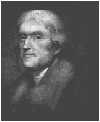
A profile of music at Colonial Williamsburg includes the face of Thomas Jefferson and documented historical concerts
''We
are trying to replicate, as much as we can, the experience that someone
in 18th-century Williamsburg would have had,'' says John Barrows, the
manager of music and dance at Colonial Williamsburg. Recognized as the
world's largest living museum, Colonial Williamsburg's 301-acre complex
is dotted with restored and reconstructed historical buildings where
costumed ''interpreters'' present history as real life, in real time.
Just as in the 18th century, music is a vital part of the experience.
''The
day is filled with music,'' says Barrows. ''Historic locations, such as
the parlors of homes, the ballroom of the Governor's Palace, and
taverns, are the settings for music performed either individually or by
small groups. Our musical staff performs concerts several nights a
week. Of course, these are concerts in the modern sense, where people
come, sit quietly, and applaud at the proper times; this is not
historic of Williamsburg in the 18th century.''
''There were about five concerts where we can actually
document tickets being sold in 18th-century Virginia,'' Barrows
continues. ''The first one we know of took place in 1771 at the Raleigh
Tavern. It's unique because they were featuring a couple of instruments
that were new to Virginia: a ![[H]](ZeichnerColonialWIlliamsburg_files/iimpft_hit.gif) glass glass  harmonica
and a pianoforte. That's the first documented reference to a pianoforte
in Williamsburg. We don't know to whom the instrument belonged, but we
do know of someone who owned both a glass harmonica
and a pianoforte from around that same time -- a man named Robert
Carter. We are not sure if they were his when they were being played or
whether he heard them and then bought them. He had everything else --
organs, guitars, violins, pretty much one of everything.'' harmonica
and a pianoforte. That's the first documented reference to a pianoforte
in Williamsburg. We don't know to whom the instrument belonged, but we
do know of someone who owned both a glass harmonica
and a pianoforte from around that same time -- a man named Robert
Carter. We are not sure if they were his when they were being played or
whether he heard them and then bought them. He had everything else --
organs, guitars, violins, pretty much one of everything.''
One of America's founding fathers was a musician. ''We
do know that Thomas Jefferson talks about going to concerts at the
Palace,'' says Barrows. ''He took his violin and joined the Governor
and three or four other gentlemen and played together. Jefferson called
them concerts, but it wasn't for an audience. He is talking more about
playing music, drinking, and talking politics.''
Jefferson would be happy to know that musical life
thrives at Colonial Williamsburg, and the current instrument collection
would have made Robert Carter proud. Keys of the Palace
(reviewed in this issue), the new recording by Colonial Williamsburg's
harpsichordist Michael Monaco, features three keyboard instruments from
the collection, which contains 25 original 18th-century instruments.
Recordings by Colonial Williamsburg musicians are true
to the spirit that animates this living museum. ''We depict the kind of
music that would have been heard here, rather than the kind of music
that musicologists would call the greatest music of the 18th century,''
says Barrows. ''We hardly ever play any Bach, but rather the kinds of
things a lady here would have been learning in her lessons, or music
you would have encountered at the theater, or some of the dances you
would have danced.''
''When the Colonial Williamsburg foundation began,''
Barrows continues, ''one of the first buildings they restored was the
Governor's Palace. In 1936, they
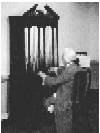 an english chamber organ in the governor's palace at colonial williamsburg, restored in 1981 by taylor & boody. an english chamber organ in the governor's palace at colonial williamsburg, restored in 1981 by taylor & boody.
p.14
 recreated a big concert there, and Ralph Kirkpatrick came down and
played the harpsichord.'' The concerts eventually featured, the Palace
Orchestra, a modern instrument band playing Baroque music. ''About
1975, we started to play in low pitch for some concerts,'' Barrows
remembers, ''but it took us till about 1985 to get the Palace Orchestra
to tune down. We had two factions here -- a modern group and a Baroque
group. Eventually the Baroque group won out.''
recreated a big concert there, and Ralph Kirkpatrick came down and
played the harpsichord.'' The concerts eventually featured, the Palace
Orchestra, a modern instrument band playing Baroque music. ''About
1975, we started to play in low pitch for some concerts,'' Barrows
remembers, ''but it took us till about 1985 to get the Palace Orchestra
to tune down. We had two factions here -- a modern group and a Baroque
group. Eventually the Baroque group won out.''
''Colonial Williamsburg is one of the few places
where someone can have a full-time job playing Baroque music, because
we play up to 200 concerts per year,'' Barrows says. The music program
has launched some careers, too. ''One woman playing with us now learned
Baroque violin here as a high school student, went off to college, got
married, and then came back with her husband to settle. We have people
who have gone to Oberlin to study after they were introduced to Baroque
music in our program, and there was a concert recently in Richmond
where 15 of the musicians had worked here with us in one way or
another.''
p.15
END Top of Page Top of Page
©Copyright 2004 Early Music America, Inc.
|