3. Before the Musical Glasses
Porcelain Instruments
Porcelain, which can superficially resemble glass, is essentially a kiln-fired clay. Unlike glass, which is formed after being heated to a molten liquid (over 650˚C/1200˚F),1 porcelain/clay is formed at room temperature and then baked. The methods of working porcelain, as well as its chemical and physical properties, are quite different from glass.
Porcelain musical instruments have their own long history, and predate musical instruments made of glass.
The author hasn’t been able to find any example of a porcelain instrument played with the ‘wet finger around the rim’. Nor has he found any porcelain wine goblet that can be made to sing with the wet-finger-around-the-rim. It would appear that porcelain cups can only be played by striking them.
The following list only includes porcelain cups and excludes, for example, wind instruments made of porcelain like the ocarina. All are played with mallets or sticks. Some are tuned with water.
Indian “Jal Tarang” and the Kama Sutra
The Jal Tarang is an Indian melodic percussion instrument. It consists of a set of ceramic or metal bowls tuned with water. The bowls are played by striking the edge with beaters, one in each hand.
The Kama Sutra lists one of the sixty four “Arts and Sciences” to be studied by a young woman as “11. [To play] a musical instrument made of cups filled with water.”2 Perhaps this refers to a Jal Tarang.
Since the Kama Sutra was written somewhere between 400 BCE and 200 CE, this may well be the earliest reference to playing music using water-filled cups.
The Japanese “Hi”
The ‘Hi’ is essentially a porcelain teacup. “Its use was suggested by the sound of drinking cups when accidentally struck.”3 No mention of more than one ‘hi’, and no mention of water tuning.
The Chinese “Shui Chan”
A 13th century Chinese encyclopedia compiled by Ma Tuan4 states that this instrument consisted of nine clay cups.5
The Arabian “Tusut”
The “Tusut” is played with sticks. The Persian Ibn Ghaybi describes a set of ‘musical bowls’ made of earthenware, whose notes were determined by the amount of water in each bowl. An author of the 9th/15th century describes a set of kizan (cups) and khawabi (jars) and their water content.6
A Persian Porcelain Instrument
An interesting example of playing porcelain cups is found in The Voyages and Travels of the Ambassadors from the Duke of Holstein to the great Duke of Muscovy and the King of Persia 1633–39 by Adam Olearius:
We were invited to sit down, and to eat of the fruit and conserves which were brought in, during which we had the divertisement of musick and dancing. And as a further honour to us, the Patriarch was sent for, who came in immediately, having about him a cassock of water’d chamlet of a violet colour, and attended by two priests clad in black, with caps on their heads. He was no ill company: but the second of the two brethren, whose name was Elias — made the best sport of any of the company. For, to heighten the divertisement of the ambassadors, he would needs play on the tamera, which is an instrument used by the Persians instead of the lute: and then, he called for seven porcelane cups, full of water, and striking them with two little sticks, he accorded them with the lute.7
Early Glass Instruments
Franchinus Gaffurius
Franchinus Gaffurius (1451–1522) was an Italian music theorist, composer and choirmaster. He was also a personal friend of Leonardo da Vinci. The son of a soldier, he was ordained a priest in 1473/4. He began his studies in Lodi, and his studies took him to Mantua and Verona. In 1477 he was called to Genoa by Doge Prospero Adorno; a year later Gaffurius followed him into exile and devoted himself to music theory. In 1480 the Plague and the invading Turks caused him to move to Lodi at the invitation of Bishop Carlo Pallavi in whose castle he stayed for three years. He accepted the position of choirmaster at the cathedral in Bargamo, but only briefly due to the War of Ferrara. In 1484 he became choirmaster at the cathedral in Milan, and later professor at the university there in 1497. When the French captured Milan in 1500 he stayed at his university post. He died in 1522 of fever.
His Theorica Musicae (Milan, 1492) contains a woodcut showing various ‘Pythagorean experiments’. (See Figure 5.) One of these experiments involves water-filled cups; it is uncertain whether these cups are made of glass.
The discovery that musically pleasing combinations of notes have simple numerical relationships is credited to Pythagoras (569–475 BCE.), and certainly at least belongs to the School he founded. For example, the relationship of the frequencies of the musical note ‘Do’ to the ‘Do’ above it (as in “Do re mi fa so la ti Do”) is 1 to 2, meaning this can be achieved by doubling the frequency (vibrations per second), or making the string half as long (all other variables remaining unchanged). The musical interval DO to DO in music has the name ‘octave’.
This much has been verified by modern physics, and it may be argued that Pythagoras’ observations mark the beginnings of Western Science as we know it: quantifying observable experience with numerical relationships.
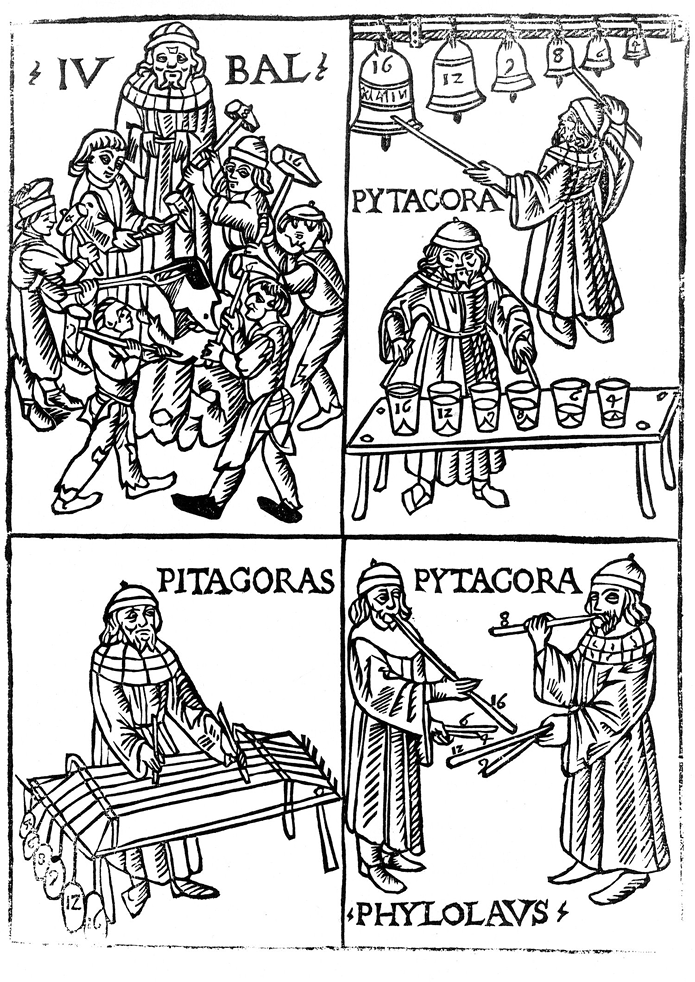
Gaffurius text accompanying the woodcut reads as follows:
After truly obtaining these sounds Pythagoras himself investigated by a number of methods whether a system encompassing all harmonies consisted in these ratios, and he attached to equal strings weights derived from the same numbers and ratios. Then by adapting the length of various pipes so as to conform to particular dimensions and experimenting with them variously he upheld his absolute trustworthiness in these matters. Often too he measured vessels of equal weight, filled them with water according to some ratio and struck them with a rod. Also, by striking bronze bells of differing weights with a bronze or iron rod he concluded that musical intervals of this kind are formed and answer each other harmoniously through the ratios themselves. Indeed the effect whereby the length and thickness of strings of bronze and gut bring notes of music together in harmony as a result of the lead taken by actual ratios is more assured when derived from this source. And by using these methods he discovered a rule which takes its name from its character, not because the rule itself by which we measure sounds and their magnitudes is in the wood or bronze, but because investigation of this kind is so firmly based that it cannot cause any investigator to come to an erroneous conclusion....
His diagram illustrates four ways of creating musical intervals, and the proportional sizes. In the upper left panel of this woodcut we see the event which legend says gave Pythagoras his insight: according to the legend, Pythagoras looks on as various blacksmiths pound the anvil, observing that different notes are produced depending on the weights of the hammers. Unfortunately this wouldn’t actually work — a hammer that is twice as heavy or twice the size of another won’t produce a note an octave different — the physics is more complex in this situation. (“IUBAL” which occurs in this panel is Latin for “Jubal,” who was considered the inventor of music.)
In the upper right panel we see bells and musical cups. With regards to the bells, contrary to what this image suggests, there is no one characteristic to which numbers can be assigned which will give the Pythagorean musical intervals: a bell that weighs twice as much as another will not necessarily be an octave lower. A bell that has twice the volume as another will not necessarily be an octave lower. A bell whose rim is twice the diameter, or circumference, as another will not necessarily be an octave lower (all other factors being equal). So the bell example doesn’t work either. The physics of bells turns out to be extraordinarily complex.
The same is true of the cups in the same upper right panel. I invite the reader to take essentially identical drinking glasses from their kitchen cupboard and see if any amount of water in them can result in a pitch difference of an octave. It can’t be done. The image would suggest that the cups are transparent, but how else could the artist show the differing levels of water? The text does not say they are of glass, simply that they are ‘vessels’ (Latin: ciatos). So the cup/glass example doesn’t work either.
The lower left hand image suggests that the Pythagorean Ratios apply to the tension of strings on a zither-like instrument. Vincenzo Galileo (the famous Galileo’s father) demonstrated that this is false also — to achieve the Pythagorean musical ratio of 1 to 2 (the octave) it is actually necessary for the string tension to be 1 to 4.
The lower right hand image is the only unequivocally correct one: all other factors being equal: two pipes — one twice as long as the other — will have musical notes an octave apart.
The Ambras Collection
The first mention of a specifically glass musical instrument appears to be in a 1596 inventory of the Ambras Collection at the Kunsthistorisches Museum (“Art History Museum”) Vienna which describes “Ein instrument von glaszwerch” (“an instrument made of glass”). This probably refers to the ‘Glasglockenklavier’ (“glass glocken-keyboard”) dedicated to Ferdinand of Tyrol, made in the second half of the 16th century and currently on display at the museum. It was a keyboard instrument, three and a third octaves in compass (F/G/A chromatically to g2/a2). It’s not possible to say if the instrument worked with glass bells or glass bars.8
“Buy My Fine Singing Glasses”
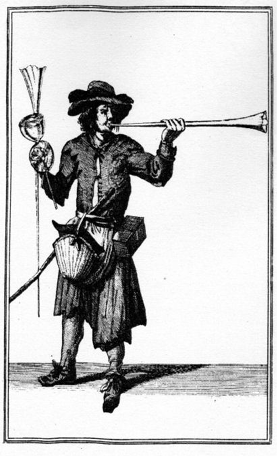
Figure 6 appears in The Cries Of London, a book consisting of a set of images of street vendors. It was first published in 1687, and reprinted frequently thereafter until well into the 20th century (when the images were reprinted as cigarette cards). Over time various images were added, and it isn’t clear exactly when this particular image appeared in this collection, but obviously it couldn’t be earlier than 1687.
Clearly the street peddler is demonstrating his wares with one hand, and holding his inventory in the other. Whatever he is selling, presumably it is cheap and simple to be a ‘street product’. Although the end of the singing glass against his lips suggests a mouthpiece, all of the glasses in his inventory have straight ends. Suppose these glasses were played like a trumpet. Then why no ‘mouthpiece’ in any of his inventory? And why wasn’t this image titled “Buy My Fine Glass Trumpet”?
Suppose you put a reed in it and play it like an oboe. Then again, no reeds are apparent in his inventory, and why wasn’t this image titled “Buy My Fine Glass Oboe”?
Perhaps the title means exactly what it says: a ‘singing glass’ is a glass for singing: you sing into it.
The (Single) Musical Glass
The Singing Wine Glass for Dummies®9
Before delving into the history of the singing wine glass per se, let’s understand the singing/musical wine glass a little better.
Essentially a musical wine glass (one capable of singing) is a glass bell. Like a conventional bell made of metal, it has a resonant frequency (a particular musical note it produces), and if energy is put into the bell somehow — by striking it, for example — it vibrates at its resonant frequencies.10
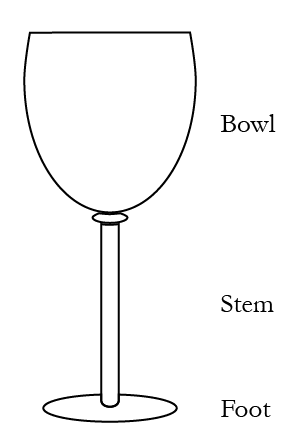
- Figure 6: Anatomy of a Wine Glass
An essential feature of a sing-able wine glass is that the walls of the bowl have to be thin enough to vibrate. You can tell if that’s the case by holding the glass by the stem in one hand and rapping the bowl with a knuckle of the other hand: if you get any sort of musical sound (as opposed to just a ‘thud’) then the glass is capable of singing. (The thinner the glass, and the louder and more bell-like the sound when doing this test, the easier it will be to make it sing with a wet finger.)
When you rub the rim of a wine glass (with thin enough sides) with a wet finger, you’re doing much the same physics as a violin player sliding the bow over the string — the ‘sticky’ bow pulls the string to one side of the violin until it can’t pull it any farther and the string slips, then on the rebound the bow catches and pulls the string again. This process repeats itself over and over hundreds if not thousands of times a second.
The exact same process occurs when you rub your wet finger around the rim of a wine glass: your finger ‘sticks’ to the rim and torques the glass until it finally slips, then on the rebound your finger is able to catch the glass and torque it again. This process repeats itself over and over (again, hundreds if not thousands of times a second), which puts energy into the (glass) bell, whose physics only allow it to vibrate at musical frequencies. And, voilà! A musical sound!
The standard wine glass works well for music making because the stem gives the player something to hold on to while their wet finger puts energy into the bowl by rubbing: if the player holds the bowl (bell) itself, this prevents the sides from vibrating — and thus no musical sound.
Adding water lowers the pitch (which the reader can verify in their own kitchen) mostly because, in effect, it adds mass to the sides of the glass, effectively making the sides heavier and thus lowering the pitch of the glass.11t
- Figure 7: Tuning a wine glass works with the water either inside or outside
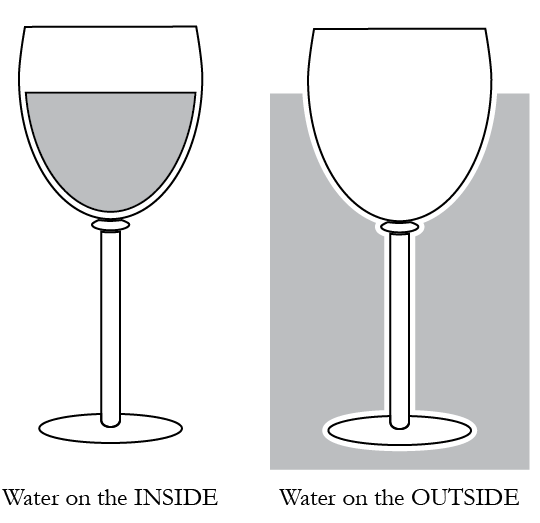
Putting water inside the wine glass lowers the pitch, and so does putting water outside of the glass! Take a wine glass and check its pitch (with the wet finger around the rim or by rapping it with your knuckle); then run some water in your kitchen sink, put the glass in the sink so the glass is mostly submerged except that the top part of the bell is above water, hold its foot on the bottom of the sink, and check its pitch again. (If it’s too submerged, you won’t be able to get it to sing at all.)
You’ll find that partially submerging the glass lowers the pitch. And having water both inside and outside of the glass at the same time lowers the pitch most of all. (Try it!)
To recap: there are two essential elements required for a musical glass: the walls of the bowl must be thin enough to vibrate easily, and it must have a stem so the player can hold the glass by the stem without dampening the vibration of the bowl. You need both — thin-walled bowl, and a stem — or the wine glass won’t sing with the wet finger around the rim.
By the way, as you make a wine glass sing with your wet finger, observe the surface of the water: you will see it make interesting patterns. With larger glasses (like brandy snifters) the pattern is easier to see. Try it!
Neither the Romans nor their Byzantine successors particularly cared about blowing thin glasses. And in fact there were very practical reasons for blowing the glasses thicker — they’d be sturdier, for example. But, as we shall see, thin wine glasses became a hallmark of the Venetian glassblowers of the 14th through 16th centuries — particularly due to their invention of cristallo. These glasses were available to the wealthy throughout Europe — for a price! And later, English glass makers had economic incentive to blow thin wine glasses.
Varieties of Glass
It’s worth taking a moment to point out that there are numerous types of glass. Sand and flux (sodium carbonate, or ‘soda’, to lower the melting point of the sand) are typical ingredients. But glass makers soon discovered that adding extra ingredients would give the glass different properties.
Recipes for glass making would fill volumes, but a few simplified examples will prove helpful in our story:
- • Soda-lime: This is the most common and least expensive kind of glass, accounting for about 90% of glass made. Common glassware, jars and windows are generally made of soda-lime glass.
- • Borosilicate: Pyrex would be a common trade name for this type of glass. Adding boron to the glass makes it resistant to shattering caused by heat differentials (hotter on one end of the glass piece than the other).
- • Lead glass: Adding lead to the mix creates a glass with marvelous optical properties.
- • Fused silica: glass made without flux: glass with flux melts at about approx.1000˚C/1800˚F; fused-silica glass (nothing but silicon dioxide — basically chemically pure sand) requires temperatures more like 2000°C/3600 °F. Fused silica is used in very high-end scientific glassware.
Shattering a Glass with Sound
We have seen how a Venetian wine glass can be shattered by placing poison in it (and how there may actually be some truth to that). In addition, if a glass is subjected to a sufficiently loud sound at exactly its resonant frequency, it can shatter. (This was much easier to do in centuries past when the quality of glass was not at modern standards.)
Scholes mentions a book by one D.G. Morhof, “an Amsterdam tavern keeper who could vocally shatter twenty-five glasses in thirty minutes.”12 And the Talmud (the compilation of Jewish civil and religious law completed 500 CE) says:
When a cock shall stretch forth its neck into the hollow of a glass vessel and sing therein in such a way as to break it, the full loss shall be paid.
When a horse neighs or an ass brays and so breaks a glass vessel, the half of the loss shall be paid.13
It’s hard to imagine roosters and horses being so loud they could break glass. But it suggests that they were aware of the possibility of shattering a glass with sound.
A rather curious sequence of articles appeared in the London Times and other London papers in 1947. On February 3, 1947, The Times printed a letter raising as a legal issue possible damage to a person resulting from the fragmentation of a glass when, on January 18, a “lady of pleasing voice was singing a beautiful aria in ‘Madame Butterfly’.” The Evening Standard in its issue of that same day went on to say that the note in question was the top B flat of “Un bel di,” sung by Miss Josie Fearon.
In the next few days The Times printed a selection from many letters received on this subject, giving instances of the shattering of glasses by causes ranging from the voices of Clara Butt, Lablache, Garcia and Caruso, to the shrill chatter of children and the tones of a schoolmistress teaching Greek! As a kind of follow-up, the Sunday Express printed the following letter on April 27 from a lady in Upminster:
Shortly after my brother drank from a glass, Lassie, our Devon sheepdog, gave a piercing bark in the yard below. The glass exploded, fragments shooting all over the room.14
Maybe the Talmud was right about barking dogs and glasses after all!
A. Hyatt King repeats an even more bizarre story by the then editor of the Strand Magazine who recalled that in 1898 it had published a story “The Luck of Pitsy Hall”...
... in which the villainess plotted to shatter a valuable goblet at a coming-of-age ball given for the Pitsy heir. She secured an orchestra to play a waltz of her own composition into which she had cunningly introduced a malignant sequence. For a repeated unison on the dominant broke the goblet by a purely acoustic agency which its guardian footmen could hardly have forestalled!15
Francis Bacon
The first mention of rubbing a wine glass rim with a moist finger is apparently by Francis Bacon (1561–1626) in his Sylva Sylvarum (1627):
Take a glass, and put water into it, and wet your finger; and draw it round about the lip of the glass, pressing it somewhat hard; and after you have drawn it some few times about, it will make a the water frisk and sprinkle up in fine dew. This instance doth excellently demonstrate the force of compression in a solid body: for whensoever a solid body, as wood, stone, metal, &c. is pressed, there is an inward tumult in the parts thereof seeking to deliver themselves from the compression: and this is the cause of all violent motion...16
Curiously, Bacon doesn’t mention the sound of it (although a few paragraphs later he talks about sound in general). I’ve tried getting the water to ‘frisk’ in glasses that don’t sing, and it looks like singing and ‘frisking’ are mutually dependent. Which is expected from our modern understanding of the physics involved — the glass is going to have to be resonating (singing) for the walls of the glass to be able to put enough energy into the water to make it ‘frisk’. (Try it! It won’t ‘frisk’ until it ‘sings’.)
The same book in which Bacon discusses ‘frisking’ of water in musical glasses is also one of the earliest known references to ‘ear trumpets’ for the hard of hearing. (Wild hypothesis alert:) might Bacon have been unable to hear the glass sing?
Galileo Galilei
If there is some question about Bacon’s discussion of the wet-finger-around-the-wine-glass-rim phenomenon because he doesn’t mention the sound, Galileo’s discussion of the same phenomenon leaves no doubt.
Galileo’s father Vincenzo Galileo (c.1525–1591) was a preeminent musician and music theorist of his day. Since antiquity, the theory of music had consisted of a mathematical discussion of harmony (based on Pythagoras’ observations), namely: what are the mathematical ratios of the lengths of strings producing consonances (pleasing note combinations)? It had ever been taught that not only was the ratio of lengths of two strings sounding an octave 2:1, but so also was the ratio of the tensions of two otherwise identical strings tuned an octave apart. Vincenzo showed that this idea — which had been accepted for centuries if not millennia — is not true at all: the ratio of tensions to produce an octave is 4:1 (all else being equal). He determined this by hanging actual weights from actual strings. (That is, he ‘tried it’!) Here was an experiment, conducted in 1588 when his 24-year-old son Galileo was living at home and giving private lessons in mathematics, that used ‘try it’ measurements to disprove an age-old theory. The example was certainly not lost on his son.
Galileo Galilei (1564–1642) himself was an accomplished amateur lute player and composer, trained by his celebrated musical father no doubt. Galileo even used his musical training to subdivide time for his physics experiments. (No chronometers until the 18th century.)17
Galileo’s wrote his last book, Two New Sciences (1638)18 while under house arrest by the Vatican. At the time he was suffering from very poor health, including the loss of sight in one of his eyes. (Medical attention was finally begrudgingly permitted after Galileo was completely blind, which occurred shortly after completing his last book). He was also grieving the loss of his beloved daughter Maria Celeste who died at age 33.
Galileo was under especially strict orders not to write anything about astronomy, so instead he wrote about the strength and resistance of materials, and the physics of moving objects — his ‘two new sciences’ — arguably founding modern physics in the process. His book encompassed thirty years of highly original experimentation, discussing aspects of the fracture of solid bodies, cohesion, leverage, the speed of light, sound, pendulums, falling bodies, projectiles, uniform motion, accelerated motion, the strength of wires, rods and beams under different loadings and placements — and the musical wine glass.
Furthermore, Galileo was forbidden to publish anything at all — “not even the Lord’s Prayer.”19 But Galileo, in spite of his failing health and eyesight, managed to publish his book anyway by heroic intrigues which kept both him and his publisher out of trouble with the Inquisition.20
Galileo knew this was his last book, and he wrote it under terribly difficult circumstances, yet he digresses for several pages to consider the wet finger around the wine glass phenomenon. Here is a sample:
If one bows the base string on a viola rather smartly and brings near it a goblet of fine, thin glass having the same tone [tuono] as that of the string, this goblet will vibrate and audibly resound [the first mention of ‘sympathetic resonance’?]. That the undulations of the medium are widely dispersed about the sounding body is evinced by the fact that a glass of water may be made to emit a tone merely by the friction of the finger-tip upon the rim of the glass; for in this water is produced a series of regular waves....21
Athanasius Kircher
Father Athanasius Kircher (1601–1680) was a Jesuit priest, German linguist, ancient historian, mathematician, vulcanologist, physicist, theologian, inventor and music theorist (to name only a few), active mainly in Rome. He has been called “the last man to know everything.”22 His encyclopedic works invited his readers to explore the connections among virtually every imaginable form of knowledge. “His books offered choice passages of forgotten texts to his readers in large folio volumes, dense with the fonts of many languages and laden with the promise of more knowledge yet to come. The fact that he was unable — or perhaps unwilling — to release all of his books and editions of the wisdom of the ages into print made him all the more interesting and enigmatic.”23
Kircher is a complex man to assess. He correctly determined that the Coptic language was descended from the language of ancient Egypt, yet his “translations” of the Egyptian hieroglyphs were pure figments of his imagination. He had the prestige and connections to build a global network of Jesuits and non-Catholic men of letters to compile the first table of magnetic declination (the amount that true north differs from magnetic north, which varies by region of the world) — something very useful for navigation.24 Yet, presenting himself as an expert in decrypting codes, he was completely unable to decipher a simple case of ‘mirror writing’ presented to him by his friends. In his lifetime he was equally venerated and vilified.
According to his autobiography,25 Kircher was:
- • Almost drowned in a pond as a child.
- • Almost hung by Protestants, but because of his piety they gave him money, returned his possessions and let him go.
- • On another occasion, to escape the Protestants, he struggled through deep snow, ill-clad and penniless, begging for food for three days.
- • Almost died from a leg infection but was cured after praying to the Virgin Mary.
- • At a horse race he was accidentally pushed into their path, but crouched motionless and emerged unscathed.
- • While crossing a river in winter, the ice he was on broke away and he floated downstream. He then swam to shore through the icy water and walked three miles through the snow to safety.26
He failed his first application to the Jesuit College in Mainz, and was admitted as a novice to the College at Paderborn in 1618. Due to misplaced humility he disguised the fact that his intelligence was far above that of his fellows, but eventually he came to his senses.27
In 1624 he taught mathematics, Hebrew and Syrian at Heiligenstadtat at the tender age of 23. During this time he published his first book, Ars Magnesia (1631) — his researches on magnetism. That same year once again the invasion of Protestant troops forced him to flee — this time leaving behind all of his manuscripts.28
Obviously Protestant Germany in those days was a bad place to be for a Jesuit priest, so Kircher’s superiors allowed him to go to France. He ended up in Avignon around 1631, where once again he nearly got himself killed — this time when he was caught in a waterwheel which he had investigated a little too closely. Meanwhile, his teaching and studies continued happily until 1633, when he was summoned to Vienna to succeed the astronomer Johannes Kepler (d. 1631) as Mathematician to the Habsburg Court.29
Since Germany was still dangerous for Jesuits, Kircher took a route through northern Italy. He embarked with some other brothers of his order, and on the first stage of their journey from Avignon to Marseilles they all became ill. So the captain landed them on an island to recuperate — and promptly sailed away with all their possessions. They managed to hail some fishermen who took them to Marseilles, whence they sailed for Genoa in a more respectable ship. After two violent storms — in one of them the captain avoided shipwreck by guiding his ship into a narrow cavern — they at last reached Genoa. After two weeks Kircher continued his journey, and yet another storm drove the ship far past its intended destination — to Civitavecchia, the main port of Rome. Obviously Kircher could not miss the chance of seeing the Eternal City, so he set out on foot for the forty-mile pilgrimage.
On reaching Rome in 1635 he found that he was expected! Friends and patrons had succeeded in having his orders changed, and he was to stay at the Roman College, the hub of the whole Jesuit Order, with a special commission to study Egyptian hieroglyphs.30 Kircher arrived in Rome while Galileo was still under house arrest — Kircher steered clear of open participation in the Copernican controversy.31
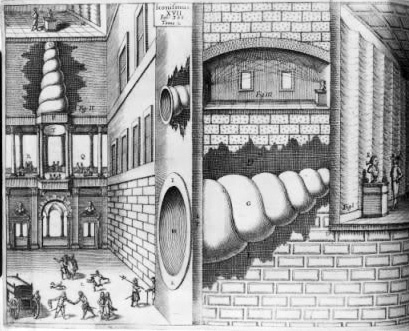
- Figure 8: A 'Mega' Megaphone from Kircher's Phonurgia Nova (1673)
In 1636 Friedrich, Landgraf of Hesse-Darmstadt, the ruler of Kircher’s home state, converted to Catholicism largely through Kircher’s efforts. He was received into the Church with great solemnity in Rome, and soon made Cardinal. Wishing to travel in Italy, he selected Kircher as his traveling companion. The party traveled south to Sicily and touched at Malta — everywhere Kircher took the opportunity to explore natural science: mirages, zoology, volcanism, and much more. When they reached Naples, Vesuvius threatened to erupt (the same volcano that claimed Pliny the Elder a millennium and a half earlier), and Kircher climbed to the top of the volcano and had himself lowered into the crater to observe it more closely.32
That was his last adventure. He was made professor of mathematics at the Roman College, a post that he held for eight years, after which he was completely relieved of his teaching duties so he could devote himself to study. Now he began to publish his major works, apparently concentrating on a different subject every three or four years. His reputation brought him scholars, letters and specimens from all over the world, and he amassed a vast collection of artifacts, curiosities of natural history, and scientific apparatus. Before his death, in fact, a large hall was provided to house the ‘Museo Kircheriano’, which was one of the world’s first museums.33
By 1678, suffering the ailments of old age, he mainly occupied himself with spiritual exercises. He died in 1680.34
One of Kircher’s thirty or so books (some of them enormous) was the Phonurgia Nova (1673), devoted to acoustics and containing all the then-known mathematics and physics concerning sound. It also includes his invention of the megaphone, as well as two experiments involving the ‘wet-finger-around-the-wine-glass’.
In the first experiment, Kircher writes:
Take a glass drinking vessel of any size whatever, which you are to fill with pure clear water. If, after doing this, you wet your index finger and rub the outer lip of the vessel in a circular movement for some time, you will after some time perceive an extraordinary sort of sound resembling ringing metal; when the water is stirred by this it will be so forcefully rippled that it appears to be set in motion by some wind.
35
Thus far, Kircher is correct. He continues:
If you fill this vessel only half-full, you will still perceive a sound, but pitched twice as high as the previous one, so that this sound will re-echo the earlier one at the perfect interval of an octave, and as a result you will observe that the rippling of the water is also more agitated...
Here Kircher is mistaken, as the reader can verify in their own kitchen with a wine glass. The range of a wine glass from empty to as-full-as-possible-yet-the-glass-can-still-sing is about a major third (‘do’ to ‘mi’ in ‘DO re MI’) — far short of the octave that Kircher claims.
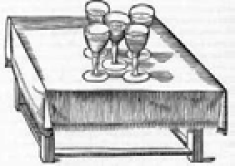
His other experiment involved five wine glasses (see Figure 10):
Let five drinking vessels of glass be taken, all of the same size and capacity, which you are to arrange so that they touch each other in the way which is portrayed here in the diagram below. Furthermore let one vessel be filled with aqua vitae (an aqueous solution of alcohol), a second with wine of the better sort, another with distilled water, another with a coarse liquid, such as sea water or olive-oil, and the central one with normal fresh water. Having done this you are to moisten a finger-tip and rub it continually on the lip of the vessel until you perceive the ringing noise which we showed you how to produce in the first experiment. For this very high pitched sound will to your amazement stir all the remaining liquids into motion, and the more violently the more one liquid surpasses another in fineness (subtlety). As a consequence the ethanol, true to its fiery or choleric nature, will leap up in the vessel more than the others; but the wine, true to its sanguine or airy nature, will undergo only a moderate agitation in its vessel. Furthermore the distilled water, which exhibits a phlegmatic constitution, will give rise to a movement that is slower and more sluggish than the others, but the coarse water contained in its vessel will, on account of its earthy make-up, be scarcely capable of any motion. One should conclude that music stirs emotions in our minds in the same manner...
No woodcut accompanies the first experiment (nor is one needed), but the woodcut of the other clearly shows wine glasses with stems — a requirement for musical glasses. Kircher makes no mention here of different levels in the five glasses to achieve different pitches. Furthermore, the author has tried Kircher’s experiment:
| For: | The author used: |
|
“Aqua vitae” (an aqueous solution of alcohol) “Wine of the better sort” “Distilled water” “A coarse liquid, such as sea water or olive-oil” “Normal fresh water” |
Vodka A nice merlot from 1998 Distilled water Olive oil Tap water |
The author simply couldn’t get the results Kircher described. (Try it!)
Based on what we now understand about the physics of acoustic resonance, Kircher’s experiment is much more likely to succeed if the glasses are tuned to the same musical note (something that Kircher doesn’t specify). So the author tuned the glasses to each other and repeated the experiment, and still didn’t get the results that Kircher described.
The author concluded his attempt at recreating Kircher’s experiment by toasting him with the glass of merlot. The glass of vodka was appropriately disposed of as well. (Historical research is a tough job, but someone has to do it!) Thus Kircher’s two ‘experiments’ with wine glasses are both problematic, particularly the second — did he actually perform them?36
Kircher was also interested in (and sometimes incorrectly credited with inventing) the ‘magic lantern’ — an early slide projector — which also has a future role in our story of the glass armonica.37
It doesn’t appear to have occurred to any of these men — Bacon, Galileo, or Kircher — to have a set of musical wine glasses tuned with water in order to play melodies. Why not? These were geniuses of their age, and Galileo in particular had extensive musical training.
Perhaps the answer is simply that, as we have seen, musical wine glasses of this period were extraordinarily rare and expensive. To play tunes on a set of a dozen glasses or so would have cost a king’s ransom, and was thus literally beyond imagining.